
How to Search Major County Warrants
The Major County Sheriff's Office runs the main public warrant tool for the county. It posts an active warrant list on the office website, and the list is open to anyone with a browser. You search it by name. The page accepts a first name, a last name, or both, then returns the matches the office has on file. Sheriff Anthony Robinson signs the notice attached to the list. Because the tool is free and needs no login, it is the fastest first stop for a Major County warrant check.
You can open the current search on the Major County active warrant list. Start with a name you can spell, since a wide search returns more hits than a narrow one.
A basic lookup takes only a few steps.
- Open the Sheriff's Office warrant list in a web browser.
- Type a last name on its own, or add a first name to narrow the result.
- Run the search and read each row for a name, city, and state that match.
- If a name appears, contact the Sheriff's Office before acting on what you see.
Note: A clear screen does not always prove that no warrant exists, so confirm anything that matters with the Sheriff's Office by phone or in person.
Major County Warrant Search Fields
The warrant list keeps its search form short. Two name fields drive every query, and neither one is required on its own. You can enter just a last name, just a first name, or both together. The results return in a small table built from a handful of columns. There is no date-of-birth box and no case-number box on the public form.
The fields and result columns break down this way.
| Field Label | Type | Required | Notes |
|---|---|---|---|
| First name | Text | Optional | Enter a first name, a last name, or both. |
| Last name | Text | Optional | Enter a first name, a last name, or both. |
| Search | Button | n/a | Runs the current warrant-list search. |
| Results columns | Result table | n/a | Returns First name, Last name, City, and State. |
Fewer fields can help. A last name on its own often surfaces every close match in a single pass.
What a Major County Warrant Record Shows
A result from the active list stays brief. It confirms identity and location more than charge detail. Each row ties a name to a place, which helps a reader tell two people apart. The public list does not print bond figures or full case files in its columns.
A listing on the active warrant search can include these fields.
- First name - the given name as the Sheriff's Office lists it.
- Last name - the family name used to match the warrant.
- City - the city tied to the listing.
- State - the state tied to the listing.
- Status - a name that appears signals an active warrant on file.
For charge text, bond, and case history, a warrant usually traces back to a District Court file. Those deeper details sit with the court rather than in the sheriff list, and the criminal case file is the place to read them.
The Major County Most Wanted List
The Sheriff's Office keeps a separate Most Wanted page apart from the routine warrant list. It profiles people the office is actively seeking and shows far more detail than a plain name match. You can view the current layout on the office Most Wanted page.
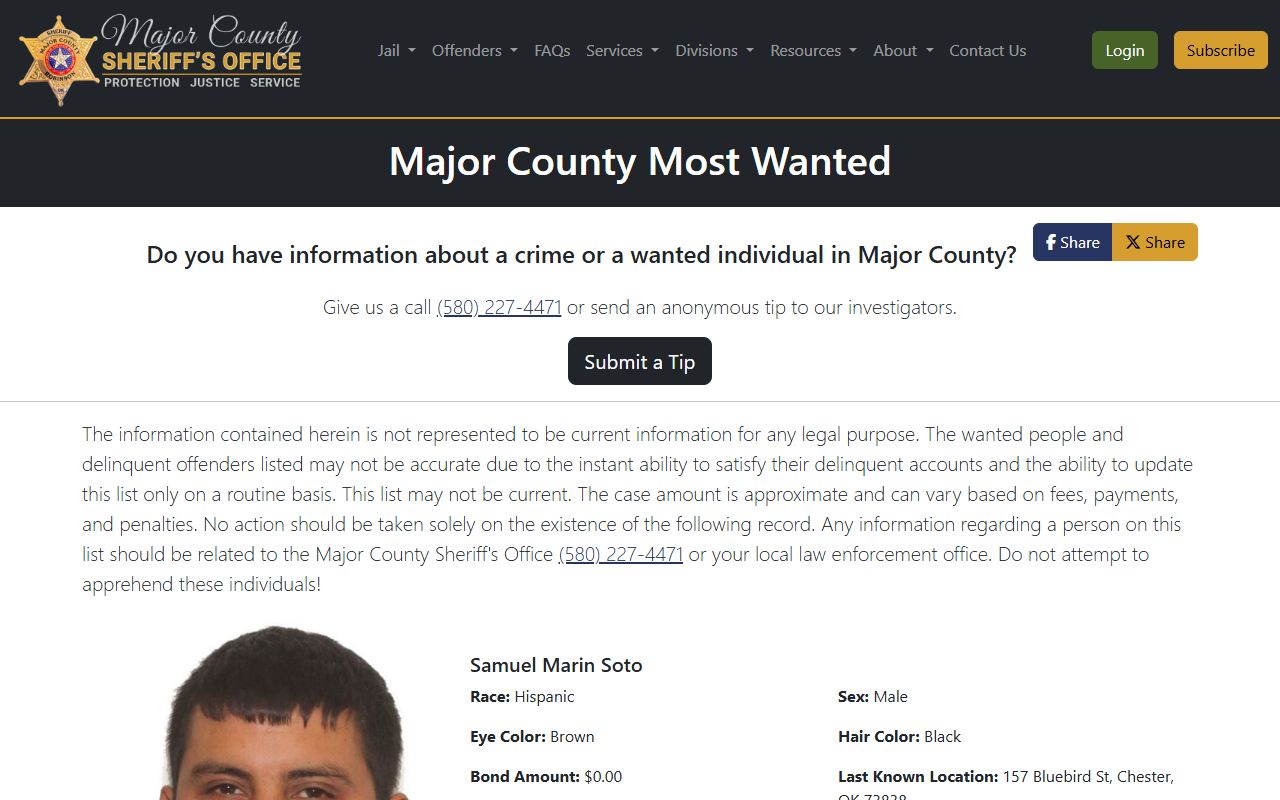
That page is where a Major County warrant for a high-priority subject often carries a full physical description. Each profile can list a person's race, sex, hair color, eye color, last known location, aliases, what they are wanted for, and a bond amount. The office notes that it is updating the list, so entries can change without notice. It asks the public to report any tips to the Sheriff's Office or local law enforcement rather than approach anyone named.
Note: The Sheriff's Office warns against trying to detain a wanted person, since that work belongs to trained officers and a tip is the safer way to help.
Voluntary Warrant Resolution in Major County
Major County has offered a walk-through option for some people with active warrants. The Sheriff's Office describes it as a chance to address a warrant in person, without being taken into custody or held in jail, as long as the person stays cooperative and works in good faith to clear it. The date fields on the program were blank when the page was reviewed, so no fixed deadline is stated here. Treat it as a current offer to confirm, not a guarantee.
A few conditions shape who can take part.
- The person must be able to post bond through a licensed bondsman at the time of the visit.
- The person must show a real, good-faith effort to resolve the warrant.
- Cooperation is required throughout the visit.
- Restrictions may apply based on the type of warrant involved.
The office frames the option as a way to avoid a later arrest and added legal cost. Call 580-227-4471 with questions about whether a given warrant qualifies.
Reaching the Major County Sheriff's Office
The Sheriff's Office shares the courthouse complex in Fairview, and it handles warrant questions the website cannot answer. You can call the main line or visit the counter in person. The administration office keeps weekday hours, while dispatch stays open every hour of the day. The same office posts a public disclaimer about the accuracy of its online records.
You can read the office accuracy note on the Sheriff's Office records disclaimer page.
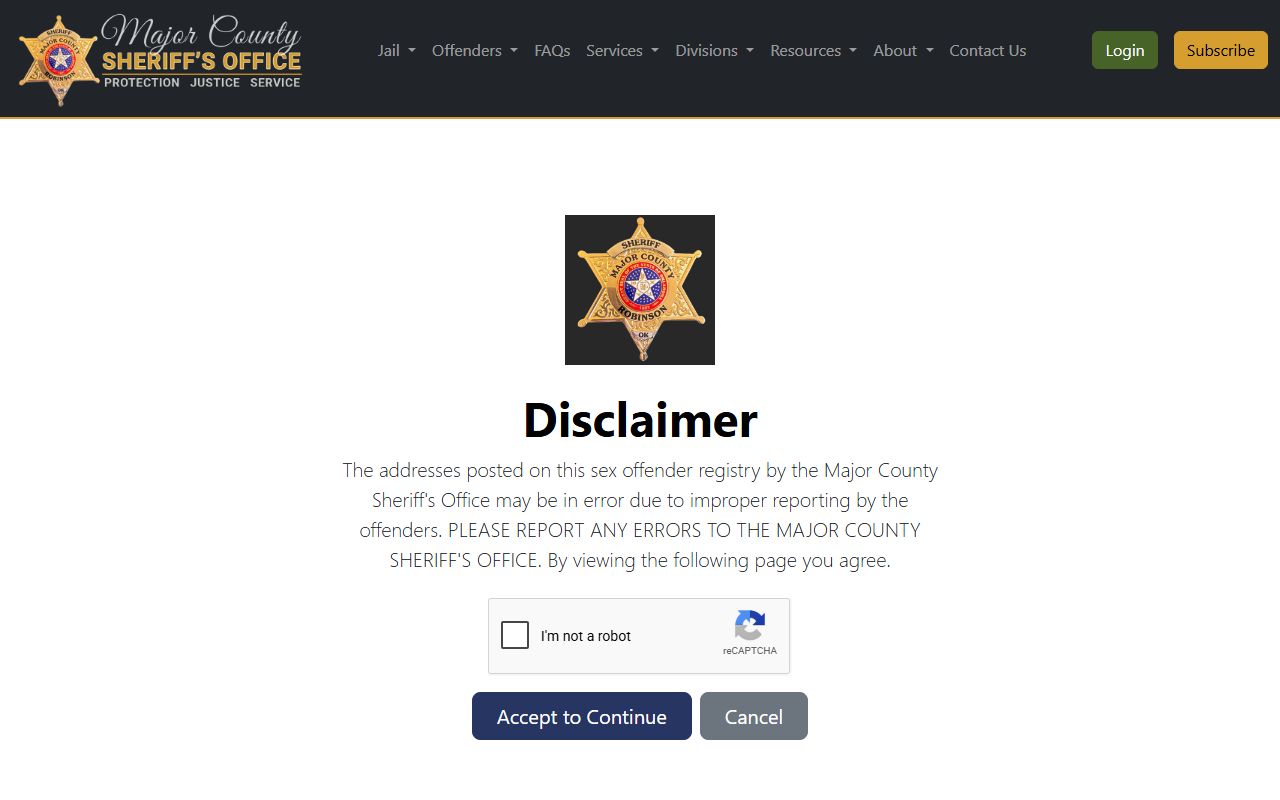
That notice is a reminder that posted information can carry errors and should be checked with the office. Use the contact details below to reach a person directly.
Major County Sheriff's Office
Sheriff: Anthony Robinson
500 E. Broadway #4
Fairview, OK 73737
580-227-4471
Administration: Monday to Friday, 8:30 AM to 4:30 PM
Dispatch: 24 hours
Bench Warrants in Major County District Court
Not every warrant comes from the sheriff list. A bench warrant is issued by a judge, often when a person fails to appear for a scheduled court date. These orders attach to an open District Court case rather than to the sheriff's active roster, so they may not show on the warrant-list search at all. The court file is where they live.
Two free statewide systems can show this kind of court activity. The Oklahoma State Courts Network, known as OSCN, and On Demand Court Records, known as ODCR, both let you search Major County District Court cases by party name or case number. ODCR lists Search Warrants as a case type and can show failure-to-appear and bench-warrant events inside a docket. The Major County Court Clerk is the office that confirms whether a bench warrant is active and how to clear it.
When a warrant is tied to a charge, the full picture sits in the Major County criminal court records, where the docket tracks the case from filing through disposition.
Municipal Warrants in Major County
City and town courts issue their own warrants too. A municipal warrant grows out of a city ordinance case or a local traffic citation, and it is handled by the court that issued it. Fairview, Ringwood, Meno, Cleo Springs, and Ames each fall under city or town authority for these matters.
No official Major County municipal warrant portal was found during this research. If a citation or warrant is municipal, the issuing city or town clerk is the right place to check status and clear it. The county sheriff list and the District Court systems will not always carry a city case, since the venue and the citation-number format can differ from a state-court matter.
Note: A municipal ticket can use a different citation-number format than a District Court case, so match the warrant to the court that issued it before you call.
Major County Warrant Records Requests
The Sheriff's Office keeps a records division that handles open records requests. It is the channel for incident reports and related law-enforcement records that the warrant list does not display. A crime victim is entitled to one free copy of their own incident report, though the victim must appear in person and show acceptable identification. Some reports can be emailed, while others are released only by subpoena.
Copy fees follow a short schedule.
| Copy Type | Cost |
|---|---|
| Paper copies | $0.50 per page |
| Certified copy | $1 per page |
| DVD or thumb drive | $1 per page |
In-person records requests are taken Monday through Friday, 9 AM to 3 PM. Bring identification and, where it applies, the case or report detail that helps staff find the file.
Checking Custody Status Through Oklahoma VINE
A warrant search and a custody check answer different questions. If you want to know whether a person is in jail, or you want an alert when that status changes, Oklahoma VINE is the free statewide tool for it. The Sheriff's Office points to VINE for inmates who have been released or moved out of county custody.
You can open the state system on the Oklahoma VINE custody search.

That system lets a victim or member of the public search custody status and register for phone or email notice when it changes. You can also reach VINE by phone at 877-654-8463. For booking detail and the current jail roster, the Major County inmate records page covers the sheriff's in-custody search and its VINE fallback.
What to Do If You Have an Outstanding Warrant
Finding your own name on the list is unsettling, but acting with a plan helps. A warrant does not go away on its own, and ignoring it tends to raise the cost over time. The safest path usually starts with legal advice and a clear sense of the bond you may owe.
These steps fit most situations.
- Confirm the warrant with the Sheriff's Office rather than trusting the screen alone.
- Talk with a licensed attorney before you turn yourself in.
- Line up a licensed bondsman so you can post bond if the walk-through option applies.
- Bring identification and any case detail when you report to the office.
Important: The online warrant list may not reflect real-time updates, and status can change at any hour, so do not rely on the website alone and never try to apprehend a wanted person yourself.