
Major County Arrest Records and Court Charges
A Major County arrest record is the account of an arrest itself. It names the person taken into custody, the arresting agency, and the booking that follows. The Major County Sheriff's Office and its jail handle that booking side. An arrest by itself does not open a court case. Once a person is arrested, a prosecutor reviews the report and decides what formal charges to file. Those charges go to the Court Clerk in Fairview, and the filing becomes the court charge record. So the arrest record and the charge record are two linked files, not one.
Keep the two sides straight. The arrest and booking detail sits with the Sheriff and jail, and the live custody list lives there too. For the booking list and current custody status, the Major County jail roster is the place to look. The charge record is different. It holds the court charges after arrest that the District Attorney actually filed, tracked as the case moves through court. The full case file, with pleas, disposition, and sentence, is covered on the Major County criminal court records page.
Who Files Major County Charges
Charges in Major County follow a set path. Law enforcement makes the arrest and books the person at the county jail. The arrest report then goes to the District Attorney. Major County sits in Oklahoma District Attorney District 26, and District Attorney Christopher Boring's office decides whether to file, what to file, and at what level. If charges are filed, they are entered in the Major County District Court, and the Court Clerk records them on the docket. The same district also covers Woodward, Alfalfa, Dewey, and Woods counties.
Sheriff arrest and booking → District Attorney charging decision → District Court filing → Court Clerk docket
The agency that starts the chain publishes its main contact details on the Major County Sheriff's Office contact page.
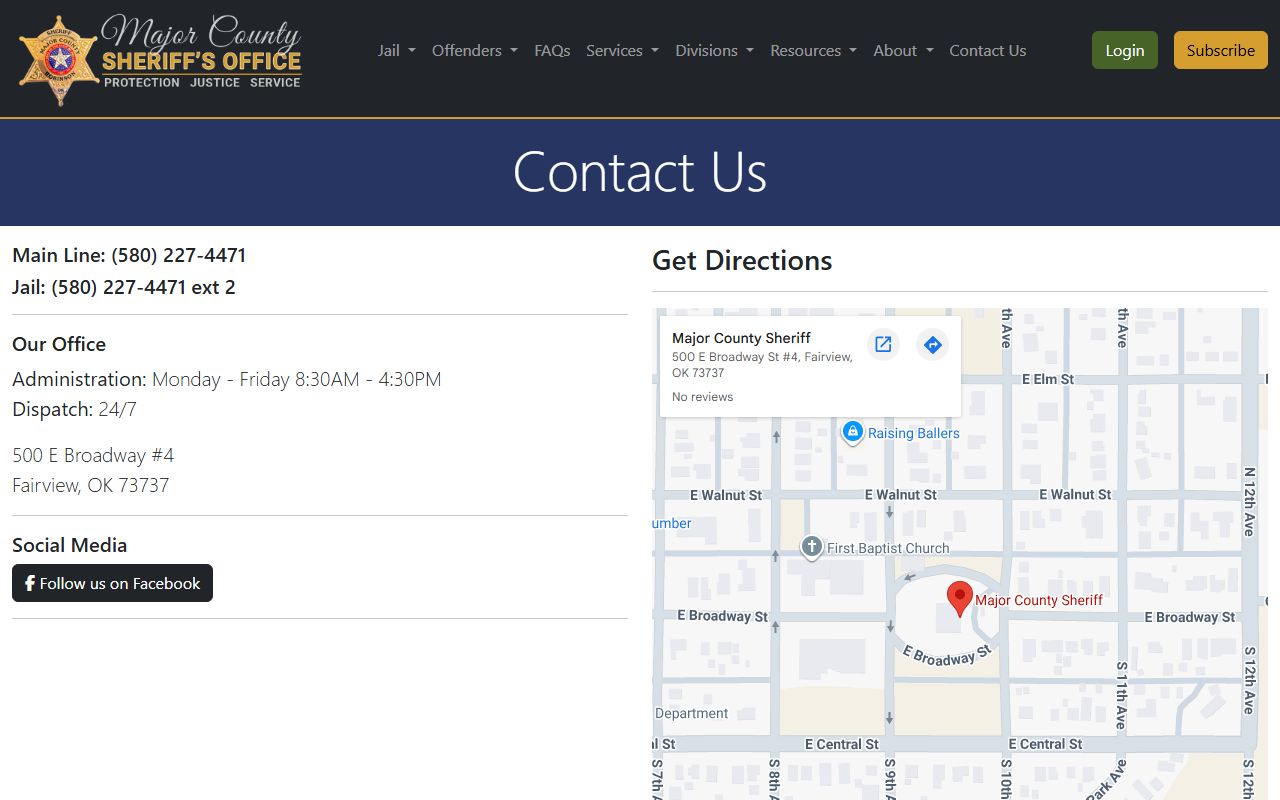
The Sheriff's Office books arrestees at the courthouse complex in Fairview, then forwards reports to the District Attorney for the charging decision. The District 26 office maintains a local presence in the Major County Courthouse, which keeps the charging step close to the court that hears the case.
Note: an arrest does not become a public charge record until the District Attorney files a charging document with the District Court.
How to Find Major County Arrest Records
Once charges are filed, they show up in Oklahoma's public court systems. Two free portals carry Major County District Court cases. On Demand Court Records, known as ODCR, is the one the Court Clerk links from its own page. The Oklahoma State Courts Network, or OSCN, is the state judiciary system and lists Major County District Court in its court dropdown. Criminal charges use case-number prefixes. CF marks a felony case, and CM marks a misdemeanor case.
- Open ODCR court search or the OSCN docket search.
- Choose Oklahoma District Courts, then pick Major from the court list.
- Search by defendant name as Last, First, or enter the case number if you have it.
- Open the case and read the charge list, then check each charge code, level, and current status.
Booking detail is not on these court portals. The jail roster holds the arrest side, while ODCR and OSCN hold the charges. For a certified copy or a file that is not online, the Major County Court Clerk in Fairview handles records in person or by phone at 580-227-4690.
How Major County Charges Get Filed
A charge record begins when the prosecutor files a charging document. The arrest happens first, at booking. The court case opens only when one of three documents reaches the court. Each one names the defendant and lists the offenses charged. Which document is used depends on how serious the offense is.
| Complaint | Information | Indictment | |
|---|---|---|---|
| Filed By | Officer or Prosecutor | Prosecutor | Grand Jury |
| Common For | Misdemeanors | Many felonies | Serious felonies |
| Starts | The case | The case | The case |
In Oklahoma most felony charges proceed by information filed by the District Attorney. A grand jury indictment is far less common and is used for the most serious matters. A complaint often opens lower-level cases.
Charge Status in Major County Records
Charges do not stay fixed. As a case moves, the District Attorney can amend a charge, reduce it, add one, or drop it. The docket shows the current status next to each count. Reading those status terms tells you where a charge stands and whether it is still open.
| Status | What It Means |
|---|---|
| Pending | The charge is filed and the case is open, with no final outcome yet. |
| Amended / Reduced | The charge was changed, often to a lower level such as a felony cut to a misdemeanor. |
| Dismissed | The charge was ended without a conviction. |
| Dismissed without prejudice | Ended, but the State may refile the charge later. |
| Dismissed with prejudice | Ended for good, and the charge generally cannot be refiled. |
| Nolle Prosequi | The prosecutor chose not to pursue the charge. |
A dropped or dismissed charge can still appear in the case history. The docket keeps the full record of what was filed and how each count was resolved.
Charges vs. Convictions
Being charged is not the same as being convicted. A charge is an accusation. A conviction is a finding of guilt by plea or by verdict. A charge record can list serious offenses that were later dismissed or reduced, so the final outcome matters as much as the original filing. Reading only the charge can give a false picture of a case.
| Charge | Conviction | |
|---|---|---|
| Stage | Accusation | Verdict or plea |
| Burden of Proof | Probable cause | Beyond reasonable doubt |
| Public Record | Yes | Yes |
Major County Charge Codes and Levels
Each charge ties to a specific Oklahoma statute and a severity level. Felonies are the most serious. Misdemeanors are lower. Minor matters can be infractions or simple citations. One arrest can produce several separate charges, and each charge carries its own code and its own status. The case header shows the count number, the offense title, and the statute reference for every charge.
This is why a single Major County arrest may show up as a list of counts rather than one line. Reading the code and level for each count tells you how serious the State treats that charge.
Major County Sheriff and Arrest Records
The arrest side of the record sits with the Sheriff. Incident reports, arrest reports, and booking information come from the Major County Sheriff's Office records division, not the court. Requests are made in person at the office in Fairview, Monday through Friday, 9 AM to 3 PM. Crime victims are entitled to one free copy of their own incident report and must appear with acceptable identification. Some reports can be emailed. A few are released only by subpoena.
The request rules and copy fees are posted on the Major County Sheriff's Office records page.
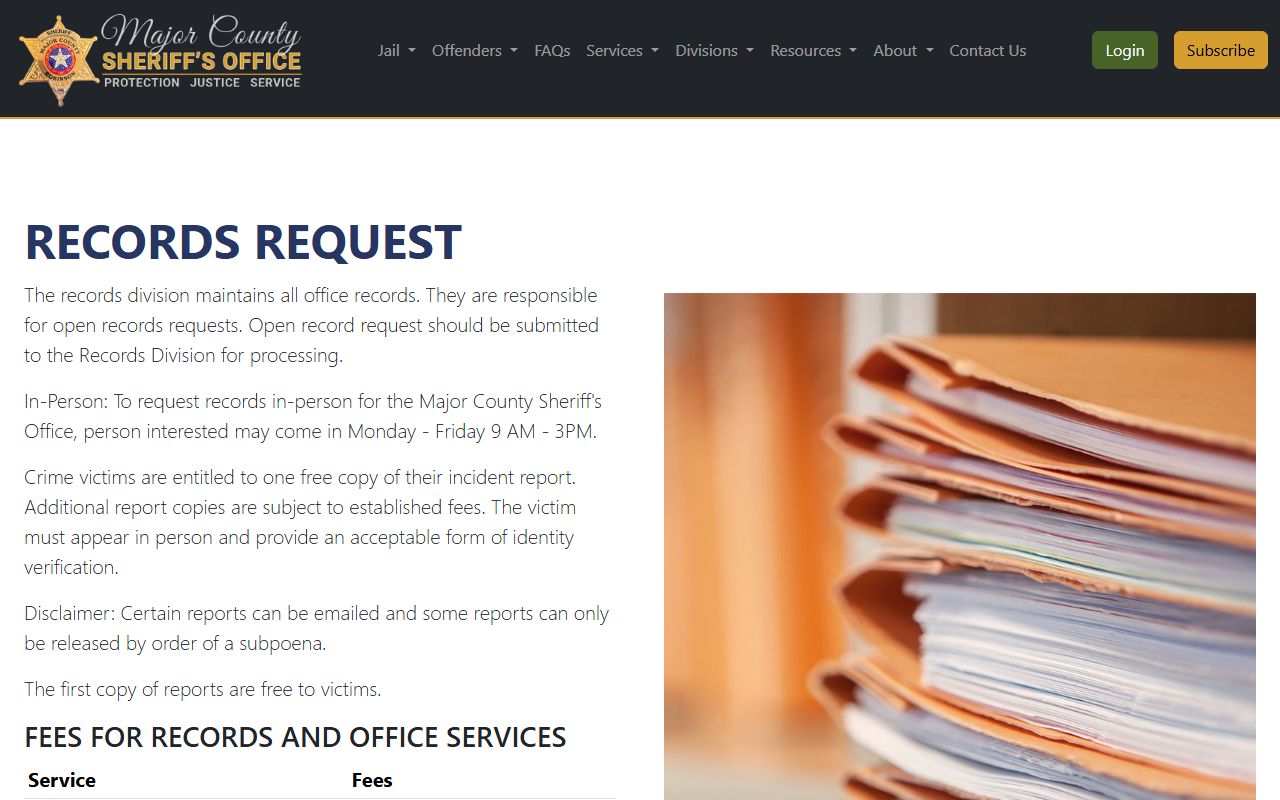
Paper copies run $0.50 per page, a certified copy is $1 per page, and a DVD or thumb drive is $1 per page. The records division is the channel for arrest reports that never reach a court docket, such as cases where no charge is filed.
Major County Sheriff's Office
500 E. Broadway #4
Fairview, OK 73737
580-227-4471
Records in person Mon-Fri 9 AM to 3 PM
Bonds and Registered Bondsmen
Bonds connect the arrest and the charge. After booking, a person may post bond to be released while the case is pending. A bond lets the defendant stay out of jail until the court resolves the charges. The Sheriff keeps rules for the registered bondsmen who write those bonds in the county.
The county's bond rules are spelled out on the Major County registered bondsmen page.
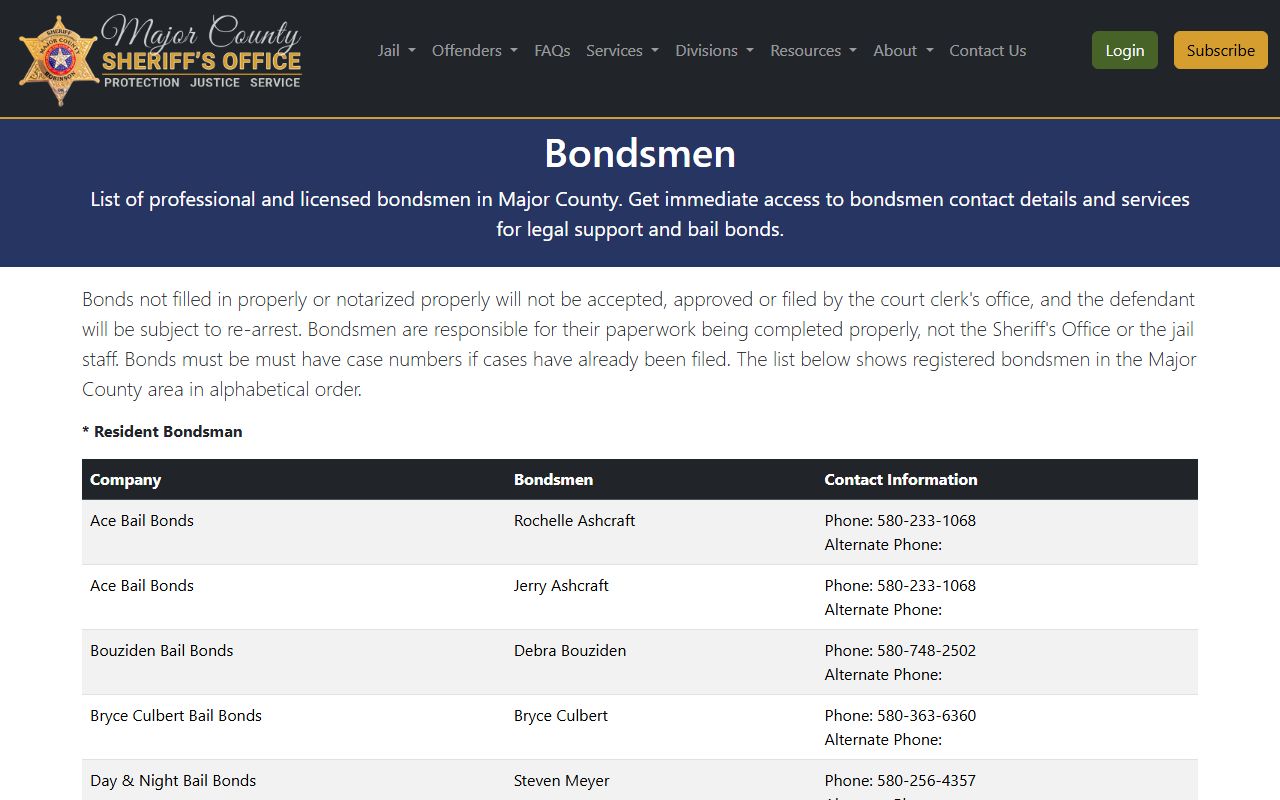
Bonds must be filled out and notarized correctly. Once a case is filed, the bond must include the court case number, which ties the bond to the charge on the docket. That case number is the link between the jail side and the court charge record.
Note: a bond posted before charges are filed still has to be matched to the case number once the District Attorney files in District Court.
Statewide Charge and History Lookups
Charges from many counties roll up into statewide systems. The Oklahoma State Bureau of Investigation keeps the statewide criminal history record, which gathers arrests and charge dispositions reported from courts and agencies. The Oklahoma Department of Corrections runs an offender lookup for people sentenced to state prison, though it warns its offense and sentence details are abbreviated. These statewide tools reach beyond a single Major County docket.
Oklahoma also maintains a public sex offender registry through the Department of Corrections. The Oklahoma sex offender registry lets the public search registered offenders.
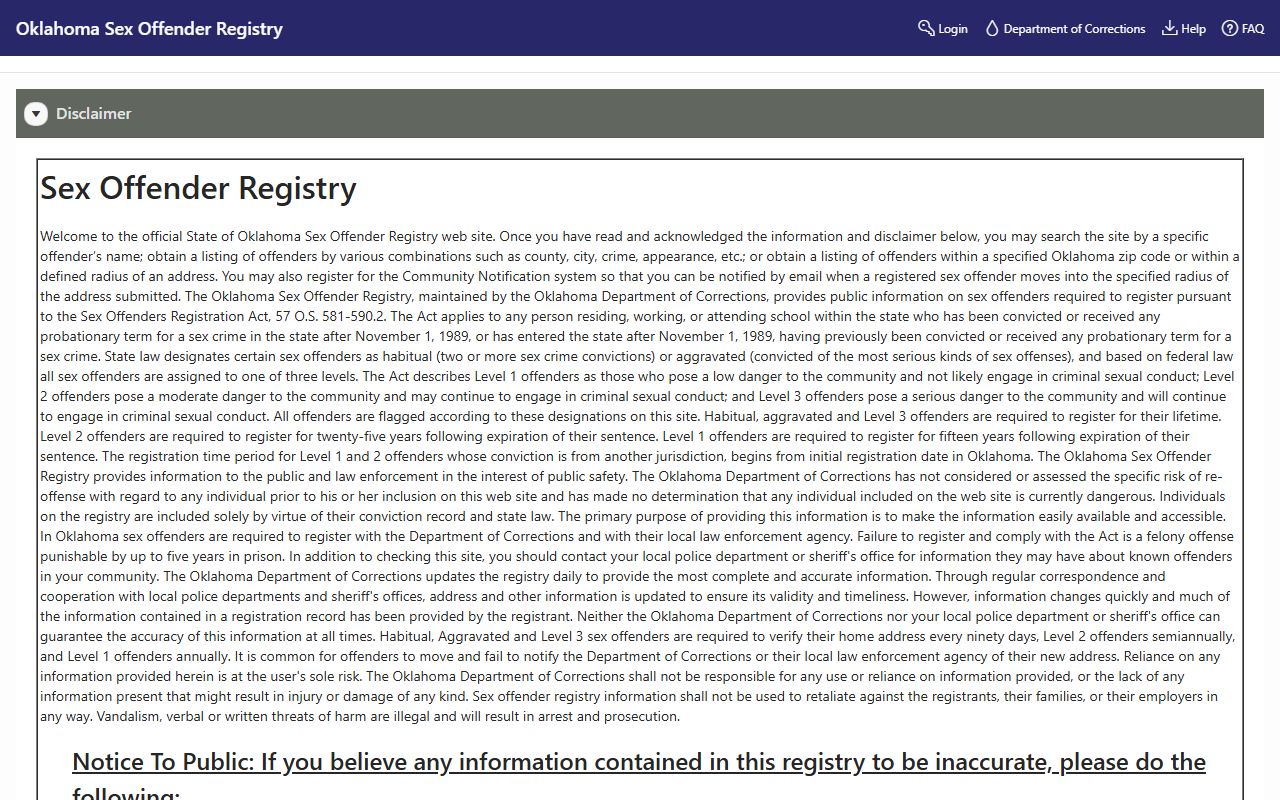
Each profile lists identifying details and the offense that placed the person on the registry. The registry is statewide, so it covers offenders tied to Major County as well as the rest of Oklahoma.
The Oklahoma Attorney General explains how the registry works and what a profile contains. The Attorney General sex offender information page gives that background.
The Attorney General points the public back to the Department of Corrections registry as the official search tool. None of these state systems replaces the county docket, but together they round out a charge or criminal-history search.
Sealed vs. Expunged Records
Some charge records are removed from public view. Oklahoma law separates sealing from expungement, and the two are not the same thing. Eligibility is set by statute, and a court order is required for either step. A dismissed charge does not vanish on its own.
| Sealed | Expunged | |
|---|---|---|
| Visibility | Hidden from public | Treated as if it never existed |
| Law Enforcement | Limited access | Very limited access |
| Eligibility | Set by statute, court order needed | Limited categories under Title 22, Section 18 |
The Oklahoma State Bureau of Investigation does not pre-approve anyone for expungement and points requesters to Title 22, Section 18. Even when a record is sealed, law enforcement may keep limited access to it.
Background Check Considerations
A casual name search is not a background check. Court portals show public dockets, but a formal background check for employment, housing, or credit must follow the federal Fair Credit Reporting Act. Those reports come from regulated screening companies, not from a public docket lookup. A charge that was dismissed or reduced should be read in light of its final status, not just the original filing.
Important: This site is not a consumer reporting agency under the FCRA, and its information may not be used for credit, employment, tenant, or insurance decisions.
Restricted Charge Records in Major County
Not every charge record is open. Juvenile charges are confidential under Oklahoma's juvenile statutes and are withheld from internet display under the Court of Criminal Appeals internet-access rule. Sealed and expunged records are closed by court order. Some pending matters may be limited, and active investigations are not public. The online docket also hides juror information and records the Legislature has made confidential.
Oklahoma's Open Records Act makes most court records public, but these categories are the exceptions. When a record is restricted, the Court Clerk can confirm what is available at the counter, since some files are open in person yet kept off the internet. Always verify a sensitive charge with the Court Clerk before relying on an online result.