
Probate Sits Inside the Major County District Court
Oklahoma does not run a standalone probate court. In Major County, probate is the Probate Division of the District Court, the same general-jurisdiction trial court that hears civil, family, and criminal matters. A decedent's estate, a minor's guardianship, or an adult conservatorship all open as District Court cases. The judges who sign probate orders are the same district and associate district judges who handle the rest of the county docket.
Because the District Court is the venue, the Court Clerk is the record custodian. That office keeps the petitions, wills, letters, inventories, and final decrees that make up a probate file. The same Court Clerk counter that handles Major County marriage and divorce records sits at the courthouse at 500 E. Broadway, Suite 5, in Fairview, and that is where probate files live. The County Clerk is a separate office and handles land records, not case files.
One courthouse holds both offices. Knowing the difference saves a wasted trip.
Major County Probate Case Types
The On Demand Court Records and Oklahoma State Courts Network systems sort District Court probate work into several case types, and the category you pick shapes the search. The label tells you what kind of estate or protective matter the file covers.
- Probate Proceedings, the main estate administration cases.
- Probate Miscellaneous, for related estate filings outside a full administration.
- Guardianships, where a guardian is appointed for a person's care.
- Conservatorship, where someone is appointed to manage property or finances.
- Trust Proceedings, for the administration of or disputes over a trust.
- Filing of Wills, where a will is deposited or admitted to the court.
These matters carry the PB case-number prefix when they open as probate cases, which makes them easy to spot in a docket list among the county's other filings.
Probate Terms Defined
Probate paperwork leans on a handful of legal terms, and a quick read of them makes any file easier to follow.
- Testator
- A person who made a valid will.
- Intestate
- Dying without a valid will, which sends an estate down a different path.
- Executor
- The person named in a will to administer the estate.
- Administrator
- The person the court appoints when no executor is available.
- Letters testamentary or letters of administration
- The court document that proves a person's authority to act for the estate.
- Guardian
- A person appointed to make personal or care decisions for another.
- Conservator
- A person appointed to manage another person's property or finances.
How to Search Major County Probate Records
Two free public systems carry Major County probate dockets. The Court Clerk's office links the public to On Demand Court Records, and the Oklahoma State Courts Network runs a parallel search. Either one lets you look up a decedent's name, a petitioner, an estate name, or a case number that starts with the PB prefix.
- Open ODCR or OSCN and choose Major from the court list, or Major County District Court in OSCN.
- Enter a party name as Last, First, whether that is the decedent, the petitioner, a guardian, or the proposed ward.
- Narrow by case type if you know it, such as Probate Proceedings, Guardianships, or Conservatorship.
- Search by the PB case number instead when you already have it from a notice or a prior filing.
- Read the case header before relying on a result, confirming the county, case type, and filing date.
- Call the Court Clerk at 580-227-4690 for a certified copy or a file that is not posted online.
The same portals power every Major County court records search, so these steps carry straight over to civil, family, and criminal dockets.
What Major County Probate Records Show
A probate file builds over the life of a case, and the public docket exposes most of the index even when scanned images are limited. The fields below appear across estate, guardianship, and conservatorship matters.
| Field | What It Shows |
|---|---|
| Decedent or ward name | The person whose estate or care the case concerns. |
| Case number | The PB prefix with the year and a sequence number. |
| Filing date | The day the petition or application opened the case. |
| Applicant or petitioner | The party asking the court to act. |
| Fiduciary | The executor, administrator, personal representative, guardian, conservator, or trustee. |
| Will and letters | Whether a will was filed and whether the court granted letters. |
| Docket events | Notices, inventory, creditor claims, orders, accounting, and the final decree. |
Documents and scanned images may carry a fee or sit behind a counter, even when the case index itself is free to read.
Where Major County Probate Records Are Kept
The Court Clerk is the first stop for any probate file, certified copy, or question about a sealed matter. The County Clerk is a separate office and only enters the picture when an estate touches real property. Both sit at the Fairview courthouse but answer different phone lines.
Major County Court Clerk
500 E. Broadway, Suite 5
Fairview, OK 73737
580-227-4690
Hours 8:30 to 4:30
Major County County Clerk
Samie Elliott, County Clerk
P.O. Box 379
Fairview, OK 73737
580-227-4732
Hours 8:30 to 4:30
Note: The Court Clerk holds the probate case file, while the County Clerk records the deeds and decrees that pass estate property, so a full search often touches both offices.
County Clerk Land-Record Cross-Check
When an estate moves real property, the paper trail can also land in the county land records, which the County Clerk publishes through the official portal at okcountyrecords.com/search/major.
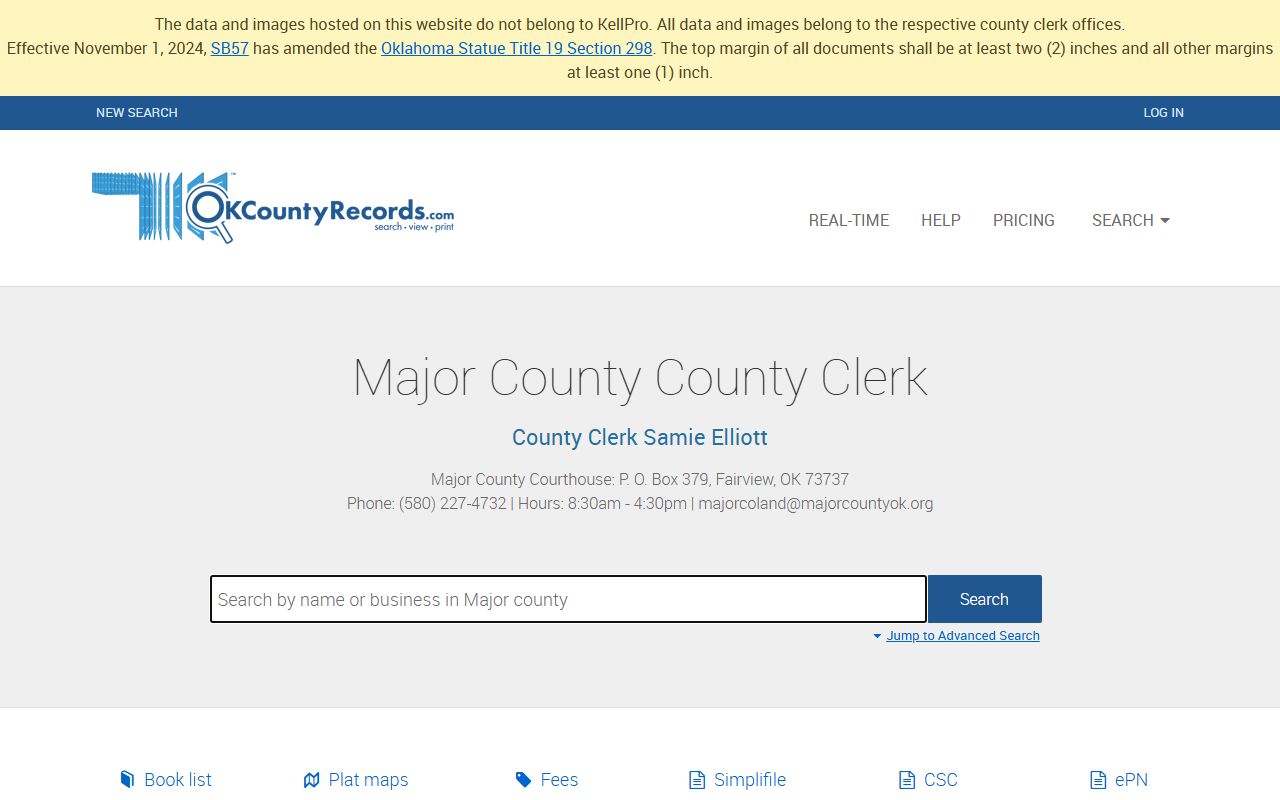
The portal indexes recorded instruments back to November 1998, with scanned images from January 1999, and its instrument-type filter includes probate-related documents alongside deeds, mortgages, and conveyances.
Recorded estate instruments can include final decrees, affidavits of heirship, affidavits of surviving trustee, amended letters testamentary, and conveyances that pass title out of an estate. Searching the grantor and grantee index by the decedent's name often surfaces these filings. This land record complements the District Court file rather than replacing it. The case file stays with the Court Clerk, and the recorded deed or decree stays with the County Clerk.
Probate Filing Fees in Major County
Major County does not publish a probate fee schedule online. The Court Clerk's page confirms that the office collects required court fees, but it does not post the dollar amounts for a probate application, for letters, or for a certified copy. No probate forms or local standing order were posted either.
Important: Probate filing and certified-copy fees were not published in Major County's official online sources. Confirm current amounts with the Court Clerk at 580-227-4690 before you file.
Quoting a fee that has not been verified can leave a filing short, so a quick call to the courthouse is the safe move.
The Major County Probate Process
A probate or guardianship case follows a predictable path through the District Court, even though timelines vary with the size and complexity of an estate. The steps below track the workflow the Court Clerk handles from opening to close.
- Confirm the venue and the case type with the Major County Court Clerk.
- Search ODCR or OSCN for any existing probate, guardianship, conservatorship, trust, or will filing.
- File the petition or application and the required supporting documents in the District Court.
- Follow the court's notice requirements, including any hearing or published notice.
- Obtain the orders or letters from the court once authority is granted.
- File the inventory, accounting, creditor claims, or final documents the case requires.
- Record any land-transfer or probate-related property documents with the County Clerk when an estate holds real property.
Paying Probate Costs and the JailATM Mix-Up
People searching for a way to pay Major County court costs sometimes land on a deposit portal at deposits.jailatm.com, which is easy to mistake for an official court-payment site.

That portal handles jail commissary deposits for inmates at the Major County jail. It has nothing to do with probate filing fees, estate costs, or any District Court charge.
Important: The JailATM portal is for jail commissary deposits only. Probate and court costs are paid to the Major County Court Clerk, never through a commissary deposit site.
Probate costs, once the Court Clerk confirms them, are paid at the courthouse counter or through the clerk's approved court-payment channel for an eligible case.
Restricted Probate Records
Most probate files are open to the public under the Oklahoma Open Records Act, yet parts of a case can be limited. Guardianship and conservatorship matters often involve a minor or an incapacitated adult, and filings with medical detail, financial identifiers, or a minor's personal data may be redacted or kept off the online docket. Mental-health commitment records carry their own confidentiality rules.
Oklahoma Court of Criminal Appeals Rule 2.6 keeps juvenile and legislatively confidential records off the internet even when they can be viewed at the clerk's counter. A sealed estate file follows the same logic. The Court Clerk decides counter access within those rules, and a judge controls anything sealed by order.
When the online docket stops short, the Court Clerk is the office that explains what is available and how to obtain it.