
Criminal Court Records in Major County
A Major County criminal court record is the case file the court opens once the state charges a person with a crime. The Court Clerk keeps that file and adds to it at every step. It is far more than an arrest log. The record starts with the charging document and grows with each motion, hearing, ruling, and payment until the case is closed. Lindsey Keck serves as the Major County Court Clerk, and that office is the legal custodian of District Court records, files, and proceedings in Fairview.
Criminal cases at the state level are heard in the Major County District Court, the general trial court for the county. District Judge Justin Eilers and Associate District Judge Timothy Haworth handle the docket. The District Court hears both felony matters, filed under a CF case number, and misdemeanor matters, filed under a CM case number. City and town ordinance violations are different. Those go through a municipal court run by the city that wrote the ticket, and they do not become District Court files. For every type of case the county handles, the full set of Major County court records covers civil, family, probate, and traffic files alongside the criminal docket.
How Criminal Charges Get Filed in Major County
An arrest does not open a court case by itself. A criminal case begins only when a prosecutor files a charge with the District Court. In Major County the path runs from the Sheriff to the District Attorney to the Court Clerk, and each office leaves its own mark on the record.
The case flow looks like this: Arrest by the Major County Sheriff › report sent to the District Attorney › charging decision by DA District 26 › charge filed in the District Court › docket opened by the Court Clerk. The District Attorney decides whether to file, what to file, and how many counts to bring. The Oklahoma District Attorneys Council page for District 26 names Christopher Boring as the district attorney and lists the local Major County office. For a closer look at the charging documents themselves and how a charge can be amended, reduced, or dropped, the Major County arrest records and court charges page tracks that side of the case.
District Attorney, District 26
Major County Courthouse
500 E. Broadway, Fairview, OK 73737
580-227-4665
Fax: 580-227-3243
How to Search Major County Criminal Court Records
Two official systems publish Major County District Court dockets for free. On Demand Court Records (ODCR) is the path the Court Clerk links from its own page, and the Oklahoma State Courts Network (OSCN) carries the same county. Both let a person search by defendant name or by case number, and both show the docket, the parties, the filing date, and the disposition once a case is final.
- Open the ODCR court search and pick Major from the court list, or use the OSCN docket search and select Major County District Court.
- Enter the defendant name as Last, First, or type the case number if it is known.
- Narrow the case type to Criminal Felony Proceedings or Criminal Misdemeanor Proceedings to filter out civil and traffic files.
- Open the matching case and read the header first, then work down the docket to the plea, the disposition, and the sentence.
- For a certified copy or a file that is not online, call the Court Clerk at 580-227-4690 or visit Suite 5 at the courthouse during posted hours.
Case numbers tell a reader what kind of case it is. CF marks a criminal felony, and CM marks a criminal misdemeanor, with the year and a sequence number after the prefix, such as CF-2014-1. Scanned document images are limited and may carry a paid plan, but the docket text itself is open to anyone. The online dockets are a starting point, not a certified court record, so the Court Clerk should confirm anything used for a legal purpose.
Stages of a Major County Criminal Case
A criminal case moves through the District Court in a set order, and each step adds an entry to the file. Reading the docket in order shows where a case stands and how it ended. The general path is short to state and long to live through.
Case flow: Charges Filed › Arraignment › Pretrial and Motions › Plea or Trial › Disposition › Sentencing.
- Charges Filed: The District Attorney files an information or complaint with the Court Clerk, which opens the case and assigns the CF or CM number.
- Arraignment: The defendant first appears, hears the charges, and the court sets bond and addresses counsel.
- Pretrial and Motions: Lawyers file motions, exchange evidence, and the case is set for hearings or a preliminary hearing in felony matters.
- Plea or Trial: The defendant enters a plea, or the case goes to trial before a judge or jury.
- Disposition: The court records the outcome of each count, whether by plea, verdict, or dismissal.
- Sentencing: The judge sets the punishment, which can include fines, costs, probation, a deferred or suspended sentence, jail, or prison.
What a Major County Criminal Court Record Shows
A District Court criminal file holds a fixed set of fields, whether it is read on ODCR, on OSCN, or at the Court Clerk counter. The header names the case, and the body tracks every event. These are the fields a Major County criminal court record most often shows.
| Field | What It Shows |
|---|---|
| Case Number | The prefix, year, and sequence, such as CF for a felony or CM for a misdemeanor. |
| Court and County | The court that holds the file, listed as the District Court in and for Major County. |
| Defendant | The person charged by the state, listed as the defendant against the State of Oklahoma. |
| Charges | The offense title, count, statute reference, and severity for each charge filed. |
| Judge | The assigned judge, often Justin Eilers or Timothy Haworth for current Major County cases. |
| Docket Events | Filings, hearings, motions, orders, bond and warrant entries, and continuances in date order. |
| Plea | The defendant answer to each charge, such as guilty, not guilty, or no contest. |
| Disposition | The outcome for each count, such as convicted, dismissed, or acquitted. |
| Sentence | The fines, costs, probation, deferred or suspended terms, and any jail or prison time. |
Reading Dispositions and Sentences
The disposition is the heart of a criminal court record. It states how each charge ended, and the sentence states what followed a finding of guilt. Several common terms appear again and again in Major County files, and knowing them makes a docket easy to read.
- Information
- A prosecutor-filed charging document used for most Oklahoma crimes.
- Complaint
- An initial written allegation that can begin a criminal matter.
- Indictment
- A charging document returned by a grand jury.
- Plea
- The defendant answer to a charge, such as guilty, not guilty, or no contest.
- Disposition
- The court outcome for a charge or the whole case.
- Conviction
- A final finding or plea of guilt.
- Deferred Sentence
- A postponed judgment that may be dismissed and later expunged in limited cases if conditions are met.
- Probation
- Court-supervised release in place of, or after, jail or prison.
- Revocation
- Court action that cancels probation or a deferred sentence after a violation.
A deferred sentence is not the same as a dismissal at filing. The charge still appears on the docket, and the case is dismissed only after the conditions are satisfied. A revocation entry shows that supervision failed and the original sentence may now apply.
Charges vs. Convictions
Being charged is not the same as being convicted. A criminal court record can show charges that were dropped, dismissed, or ended in an acquittal. A charge is an accusation that the state must still prove, while a conviction is a final result. Reading the disposition line, not just the charge line, is the only way to tell the two apart.
| Charge | Conviction | |
|---|---|---|
| Stage | Accusation filed by the state | Verdict or plea of guilt |
| Burden of Proof | Probable cause | Beyond a reasonable doubt |
| Can Change | May be amended, reduced, or dropped | Final unless appealed or vacated |
| Public Record | Yes | Yes |
Drug Court and Specialty Dockets
Some criminal cases in Oklahoma route into a treatment-based docket instead of a standard sentence. Adult drug court gives eligible, non-violent felony defendants a structured, court-supervised treatment program in place of incarceration. The Oklahoma Department of Mental Health and Substance Abuse Services reports that drug courts now run in 73 of the state 77 counties.
The structure of these programs is laid out on the Oklahoma ODMHSAS adult drug court page, which explains eligibility and the treatment model statewide.
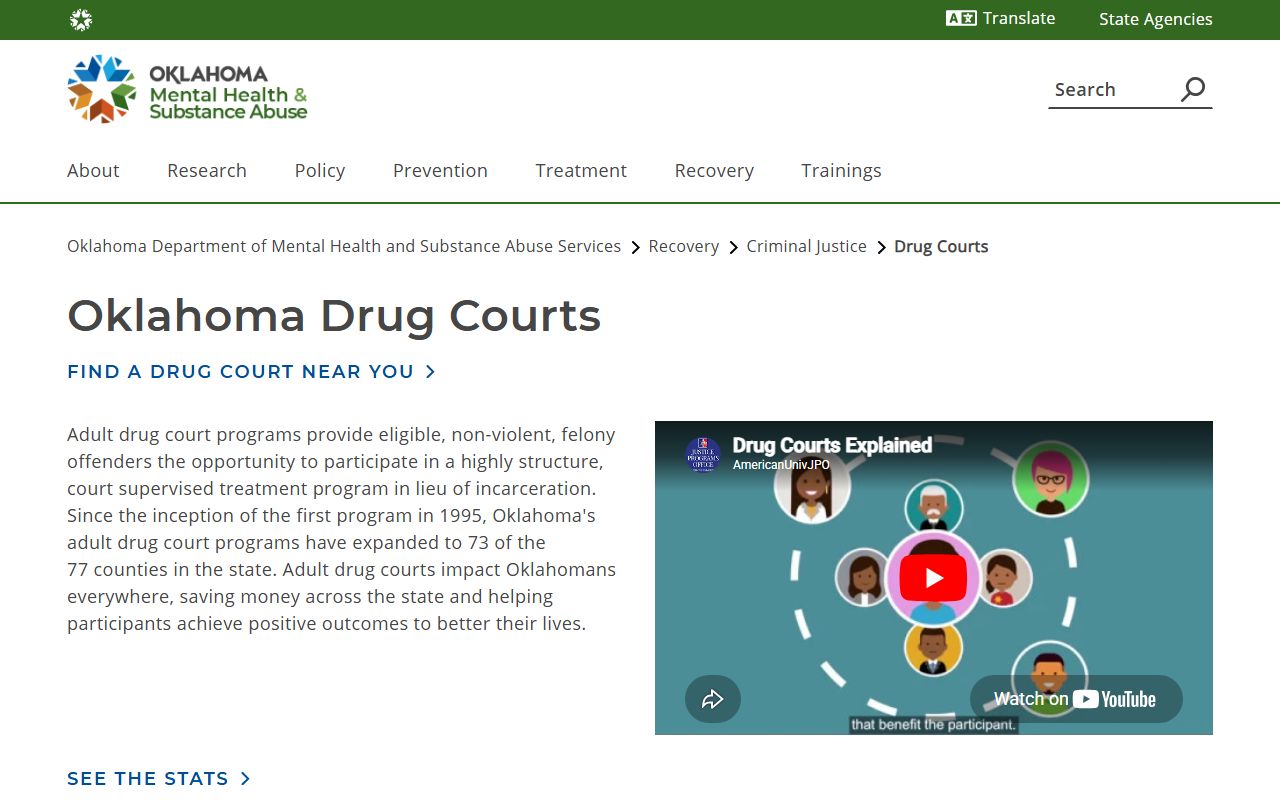
ODCR case types do list Drug Court and Mental Health Court categories, so a searcher may see those labels on an Oklahoma case even when the program is managed regionally. No standalone Major County drug-court docket is confirmed in county sources, so the Court Clerk or District Attorney should be asked about current local availability. The enforcement side is separate from treatment court. The Oklahoma District Attorneys Council lists Major County under the OBN and District 26 drug task force, reachable at 800-522-8031.
The task force coverage can be checked on the Oklahoma drug task force locator, which maps each district to its enforcement unit.
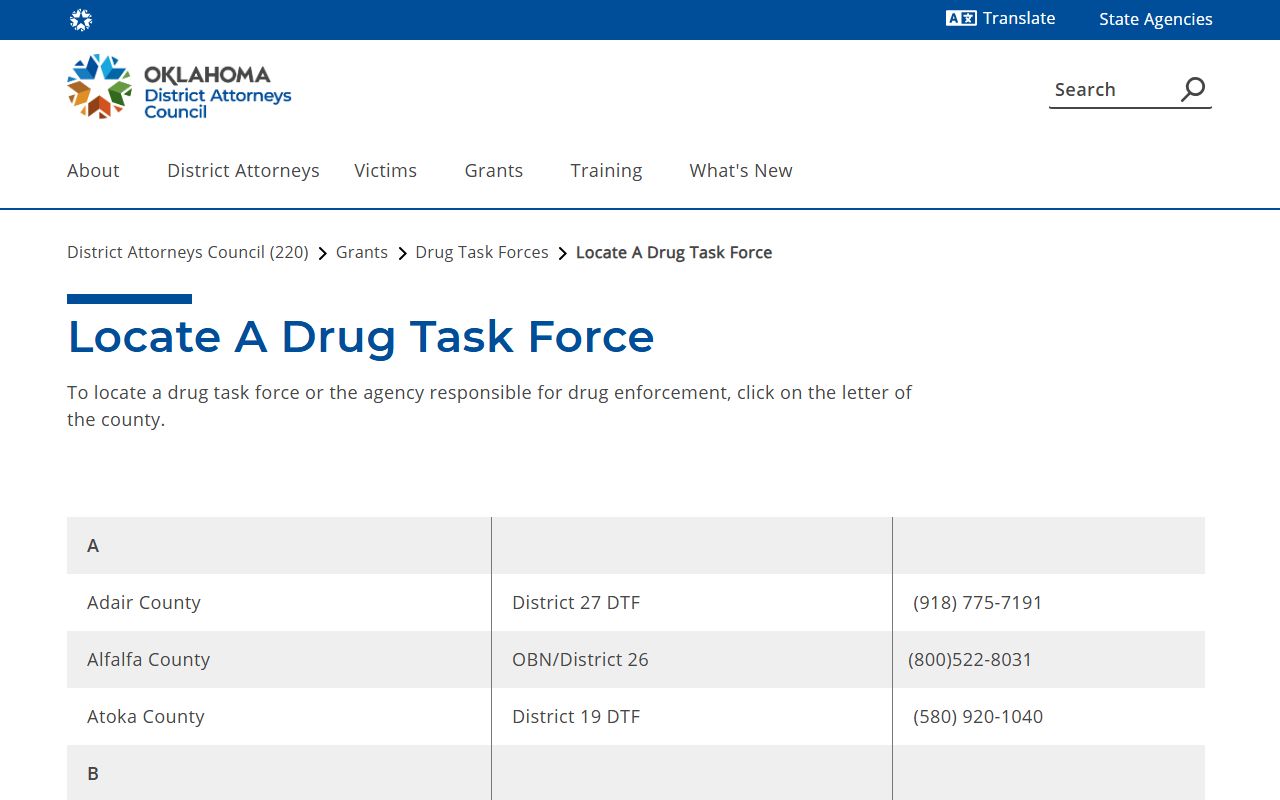
The locator confirms that drug-enforcement context for Major County sits with District 26, which is useful background but is not a treatment-court docket on its own.
Indigent Defense in Major County Criminal Cases
A defendant who cannot afford a lawyer may qualify for appointed counsel. Major County falls under the Oklahoma Indigent Defense System non-capital trial coverage, handled out of a regional office. The case file will show whether counsel was appointed and which office took the case.
The coverage area and office details appear on the OIDS Major County coverage page, which lists the satellite office and the division chief.
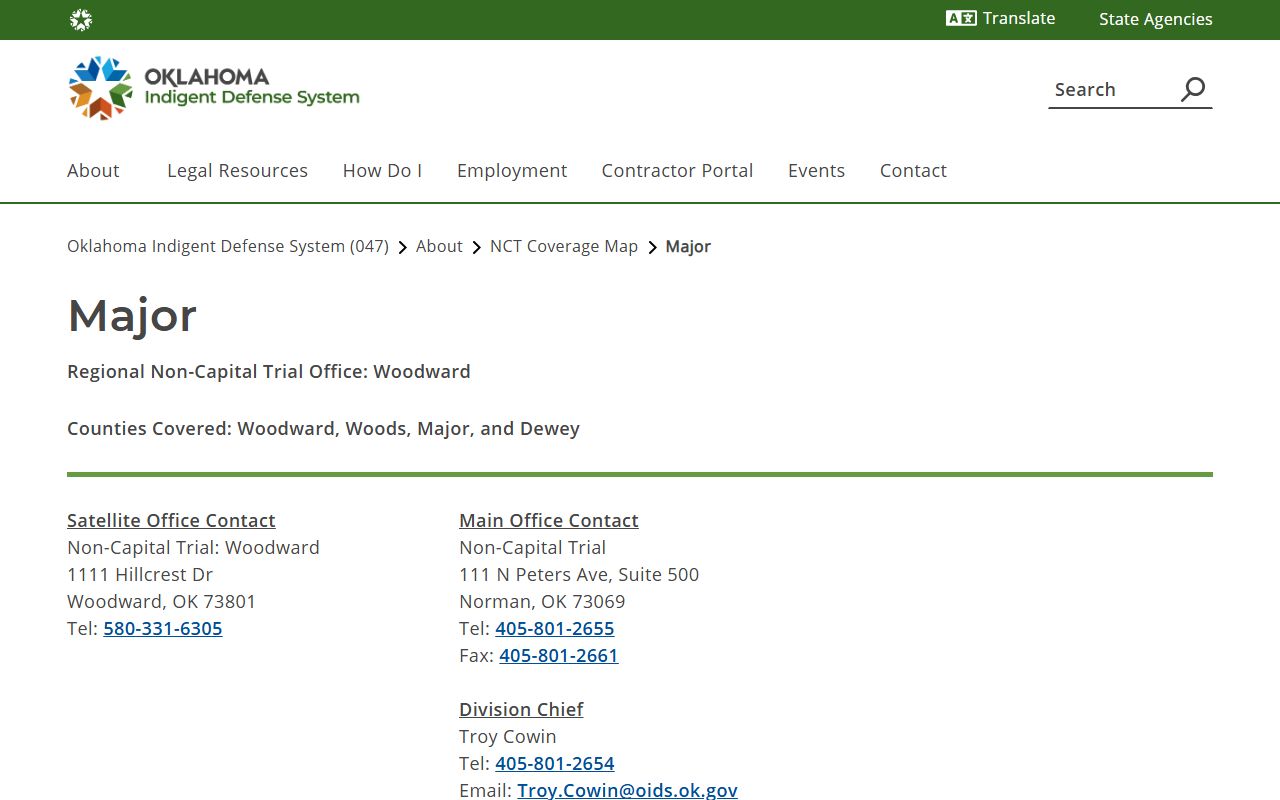
The coverage map points a Major County defendant to the regional trial office that takes appointed cases.
Oklahoma Indigent Defense System, Woodward Office
1111 Hillcrest Dr, Woodward, OK 73801
580-331-6305
Coverage: Woodward, Woods, Major, and Dewey counties
The same OIDS map shows a main office in Norman and names Troy Cowin as the division chief for this non-capital trial region. The Woodward satellite is the closest point of contact for a Major County defendant who needs appointed trial counsel.
Public Access to Major County Criminal Court Records
Criminal case files are public records in Oklahoma. The Open Records Act requires public bodies to provide access to public records unless a specific exception applies, and District Court criminal dockets fall squarely inside that rule. The online systems carry most of what the public may see, while the counter at the Court Clerk holds the certified files.
The expungement and access rules trace back to the official statutes, and Title 22 sets out who may seek to clear a record, as shown on the Official Oklahoma Statutes Title 22, Section 18 page.
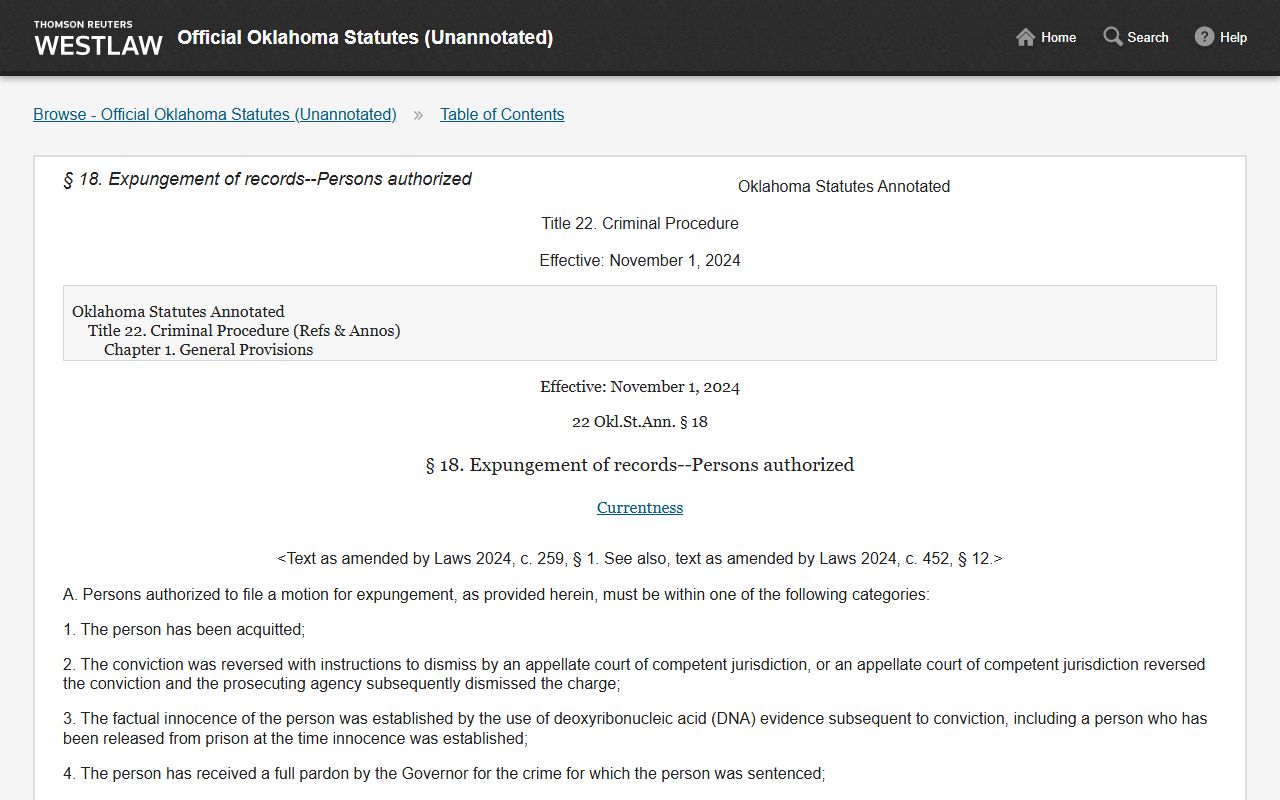
That statute, along with the rules below, frames what a Major County criminal court record reveals and what stays out of public view.
Key Statutes:
Oklahoma Open Records Act, 51 O.S. § 24A.1 - public bodies must give access to public records unless a stated exception applies.
Oklahoma Court of Criminal Appeals Rule 2.6 - some records stay open at the clerk counter but are withheld from internet display, including juvenile and legislatively confidential records.
Oklahoma Statutes Title 22 § 18 - lists who is authorized to seek expungement of a criminal record.
Sealed vs. Expunged Records
People often use sealed and expunged as if they mean the same thing. They do not. A sealed record is hidden from public view but still exists for limited official use. An expunged record is treated under the law as if it never existed. Both require statutory eligibility and a court order, and neither is automatic when a charge is dismissed.
Eligibility runs through Title 22, Section 18, and the state criminal-history office spells out that it cannot pre-approve a request, as explained on the OSBI criminal history record expungement page.
That OSBI guidance sets the eligibility floor, and the two relief paths differ in how completely they remove a record.
| Sealed | Expunged | |
|---|---|---|
| Visibility | Hidden from public view | Treated as if it never existed |
| Law Enforcement | Limited official access | Very limited access |
| How It Happens | Court order under statute | Court order under 22 O.S. § 18 |
| Eligibility | Set by Oklahoma statute | Set by Oklahoma statute, no OSBI pre-approval |
A record does not vanish from every system the moment a case is dismissed. Sealing or expungement takes a petition, statutory eligibility, and a judge ruling, and the order must then reach each agency that holds the record. No site can promise to clear a record, because only a court can grant that relief.
Restricted Criminal Court Records in Major County
Not every criminal matter is open to the public. Oklahoma law makes juvenile court records, juvenile law-enforcement records, district-attorney juvenile records, and related social records confidential. Court of Criminal Appeals Rule 2.6 keeps those files, along with juror personal information and legislatively confidential records, off internet display even when a public docket exists.
Sealed and expunged cases are also restricted, and access usually requires a statutory role or a court order. A felony with an active bench warrant may show in the sheriff warrant list rather than as an open hearing on the docket. When the online systems come up short, the Court Clerk is the office that confirms what a file holds and issues certified copies.
Note: A dropped or dismissed charge can still appear in a public criminal court record until a court grants sealing or expungement under Oklahoma law.