
How to Search Major County Court Records
Most Major County District Court cases are searched through two free statewide tools. The first is On Demand Court Records (ODCR), which the Major County Court Clerk links from its own office page. The second is the Oklahoma State Courts Network (OSCN), the judiciary's official docket system. Both let a person look up a case by name or by case number without a fee. ODCR is often the better starting point for Major County because the clerk points the public to it directly.
Before you start, it helps to know either the full name of a party or the case number. Major County case numbers carry a prefix, a year, and a sequence, such as FD-2019-00024 for a family case or CF-2014-1 for a felony. A short list of steps keeps a search on track.
- Open ODCR and pick Oklahoma District Courts, then choose Major from the court dropdown to limit results to the local court.
- Enter a party name as Last, First, or type a known case number to jump straight to a file.
- Add a case type only if you know whether the matter is criminal, family, probate, small claims, or traffic.
- Read the case header first, and confirm the county, the filing date, and the parties before you rely on a result.
- For a certified copy or a file that is not online, call the Court Clerk at 580-227-4690 or visit Suite 5 during posted hours.
ODCR uses a small set of search fields. Knowing what each one does makes the difference between a clean result and an error notice.
| Field | Type | Notes |
|---|---|---|
| Court group | Dropdown | All Courts, Oklahoma District Courts, or Tribal Courts. |
| Court | Dropdown | Select Major to focus on the Major County District Court. |
| Party name | Text | Format is Last, First. |
| Party type | Dropdown | Plaintiffs and Defendants, or All Parties. |
| Type of case | Dropdown | Criminal felony, misdemeanor, family, probate, small claims, traffic, and more. |
If too little information is supplied, ODCR returns a notice that more search detail is needed. The scanned document images on ODCR are paid and limited, so the docket text is what most users read for free.
The Major County Judicial System
Oklahoma runs a unified state court system, and Major County has one District Court for nearly every kind of state case. District judges hear both civil and criminal matters, and the District Court is the place where lawsuits, felonies, divorces, probate cases, and most traffic filings begin. The current bench listed on the clerk's office page includes District Judge Justin Eilers and Associate District Judge Timothy Haworth. Appeals do not stay in the county. They move up to the state appellate courts, and they split by subject.
Civil appeals travel to the Oklahoma Supreme Court, while criminal appeals go to the Oklahoma Court of Criminal Appeals. The Court of Civil Appeals handles cases that the Supreme Court assigns to it. Below the District Court, a Municipal Court in a city or town handles local ordinance violations and many local traffic tickets. Major County did not have a dedicated municipal court site located during research, so the citation itself or the city clerk is the routing source for a municipal ticket.
Case flow: Municipal Court › Major County District Court › Oklahoma Supreme Court for civil appeals or Oklahoma Court of Criminal Appeals for criminal appeals
| Court | Jurisdiction | Case Types |
|---|---|---|
| Oklahoma Supreme Court | Highest civil appellate court | Civil appeals from district courts |
| Court of Criminal Appeals | Highest criminal appellate court | Criminal appeals from district courts |
| Court of Civil Appeals | Intermediate appellate court | Civil cases assigned by the Supreme Court |
| Major County District Court | General jurisdiction trial court | Civil, criminal, family, probate, traffic, juvenile |
| Municipal Court | City or town ordinance court | Municipal violations and local traffic citations |
Two offices keep different kinds of records, and people often confuse them. The Court Clerk holds the District Court case files. The County Clerk holds land records and other county documents. The comparison below shows where each record lives.
| Point | Court Clerk | County Clerk |
|---|---|---|
| Holds | District Court case files, dockets, marriage licenses | Deeds, plats, mortgages, recorded instruments |
| Search tool | ODCR and OSCN | OKCountyRecords land portal |
| Contact | 580-227-4690 | 580-227-4732 |
| Use for | Lawsuits, charges, divorce, probate cases | Property, liens, heirship, oil and gas filings |
Types of Court Records Available in Major County
The Major County District Court produces a wide range of records because it handles almost every state case type in one place. Civil files cover lawsuits, money damages, small claims, judgments, liens, and garnishments. Criminal files cover felonies, misdemeanors, probable cause matters, search warrants, and youthful offender cases. Family files cover divorce, custody, support, and protective orders. Probate, guardianship, and trust matters round out the list, along with traffic tickets filed at the state level.
Each record type tells a different story, and the office that keeps it can vary. The categories below are the ones a Major County searcher meets most often.
- Criminal records - the full case file after charges are filed, including the charge text, bond events, plea, and sentence.
- Civil records - petitions, answers, motions, orders, judgments, and release filings in money and property disputes.
- Family and divorce records - dissolution, custody, and support cases, with some sensitive filings limited from public view.
- Probate records - estate, guardianship, conservatorship, and trust matters filed as District Court cases.
- Traffic records - state traffic tickets, wildlife citations, and related fines payable through the court system.
Municipal violations stand apart. A ticket written by a city or town may run through a municipal process and may never appear in the District Court systems, so the citation controls which court holds the file.
What Major County Court Records Show
A Major County court record is built from a set of standard fields. A search result first shows a header with the court, the county, the parties, the case number, the case category, the filing date, and the assigned judge. Below the header sits the docket, which logs every filing, hearing, order, and payment in date order. For criminal cases, the record also carries the charge text, the statute, the severity, the disposition, and the sentence.
A real Major County example helps. The search result for case FD-2019-00024 reads as a dissolution of marriage filed on August 22, 2019, before Judge Timothy Haworth, with the parties listed as plaintiff and defendant. The table below maps the common fields to what each one tells a reader.
| Field | What It Shows |
|---|---|
| Case Number | A prefix, year, and sequence such as FD-2019-00024 or CF-2014-1. |
| Filing Date | The date the case was opened with the court clerk. |
| Parties | Plaintiff and defendant, petitioner and respondent, or state and defendant. |
| Charges / Cause | The offense title and statute for criminal cases, or the claim for civil cases. |
| Disposition | The court outcome, such as a plea, judgment, dismissal, or final decree. |
| Sentence / Judgment | Fines, costs, probation, and any later revocation or expungement activity. |
Some fields stay hidden online. Juvenile data, sealed cases, juror personal information, and records the Legislature made confidential are redacted or kept off the internet, even when the docket header is visible.
Public Access Laws for Major County Court Records
Court records in Major County are public by default. The Oklahoma Open Records Act treats most government records as open unless a specific exception applies. Court display rules then decide what shows up online versus what stays at the clerk's counter. A solid grasp of the law tells a searcher where to look and what to expect when a record does not appear in a free search.
A short look at the open records framework points to the controlling statute index that the state publishes for the public.
The Oklahoma Open Records Act statute index, published by the state, is shown on the page linked here on Oklahoma.gov.
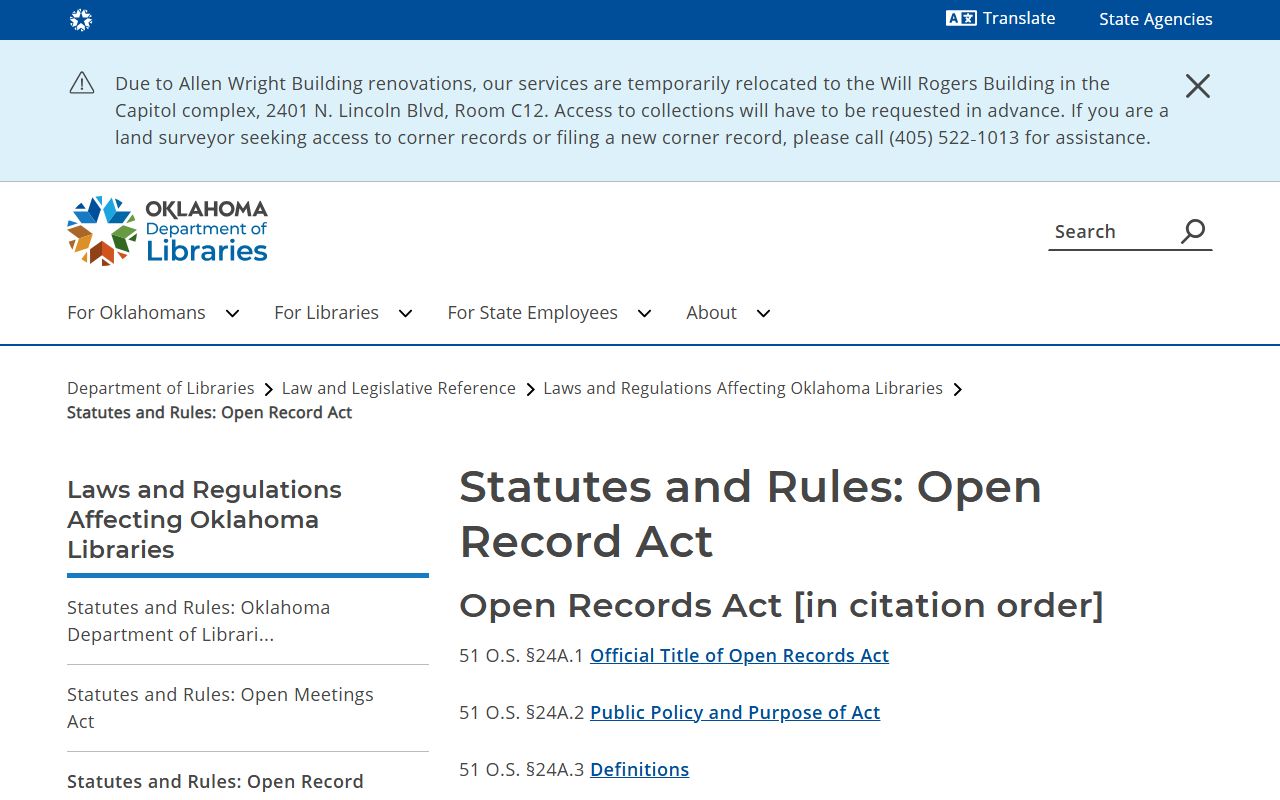
That index anchors the public right of access that lets anyone read Major County case dockets. The four rules below set the boundaries that matter most for court files.
Key Statutes:
51 O.S. § 24A.1 - the Oklahoma Open Records Act requires public bodies to give access to public records unless an exception applies.
OCCA Rule 2.6 - certain records stay open at the clerk's counter but are withheld from internet display, including juvenile and confidential records.
22 O.S. § 18 - sets out who may ask a court to expunge eligible criminal records from public access.
10A O.S. § 1-6-102 - makes juvenile court, agency, and law enforcement juvenile records confidential and closed to the general public.
When a result is incomplete, old, or image restricted, the Court Clerk is the next stop because that office maintains the District Court records, files, and proceedings. The Oklahoma State Bureau of Investigation also notes on its expungement page that it cannot pre-approve eligibility and directs requesters to the statute.
Records That Are Restricted or Confidential
Not every Major County record is open to the public. Juvenile court files, agency records, district attorney juvenile records, law enforcement juvenile records, and social records are confidential under Oklahoma juvenile statutes. Court of Criminal Appeals Rule 2.6 reinforces that these records stay off internet display. Access usually requires a statutory role, proper credentials, or a court order.
Sealed and expunged records work the same way. A charge that was dismissed does not vanish from every system on its own. Expungement is a statutory process with eligibility rules under 22 O.S. Section 18, and it takes a petition, a hearing, and a signed order before agencies remove public access. A practical path starts with the exact case number from ODCR, OSCN, or the Court Clerk, then a check of the outcome against the statute, then a filing in the proper court with notice to agencies such as OSBI. Fees for filing and certified copies were not posted in Major County's online sources, so the Court Clerk should confirm current costs by phone.
Note: A dismissed or paid case may still appear on an online docket until a court order is processed, so confirm any sealed status with the Court Clerk before assuming a record is closed.
Specialty Courts and Major County
Specialty court programs in Oklahoma route eligible defendants into structured treatment instead of standard incarceration. The Oklahoma Department of Mental Health and Substance Abuse Services explains on its adult drug court page that these programs serve eligible, non-violent felony offenders through close court supervision, and that drug courts now operate in most Oklahoma counties. Mental health court categories also exist in the statewide systems.
No county-specific specialty court program page was located for Major County in official sources, so a standalone local drug court docket cannot be confirmed here. Even so, ODCR case types include Drug Court and Mental Health Court categories, which means a searcher may see those labels in the state systems even when a program is managed regionally or by judicial district. For current docket availability, the Court Clerk or the District Attorney office is the right place to ask. The District Attorneys Council drug task force locator also lists Major County under the District 26 task force, useful for law enforcement context rather than a treatment docket.
Major County Sheriff and Jail
The Major County Sheriff's Office shares the courthouse complex at 500 E. Broadway in Fairview and runs the county jail. Sheriff Anthony Robinson leads the office, with a main line of 580-227-4471 and a jail extension of 2. Administration runs Monday through Friday, while dispatch stays available around the clock. The office publishes an online inmate roster, an active warrant list, and a records request channel for incident reports.
The Major County Sheriff's Office homepage, with its inmate search and most wanted tools, is shown on the site linked here at majorcosheriff.com.
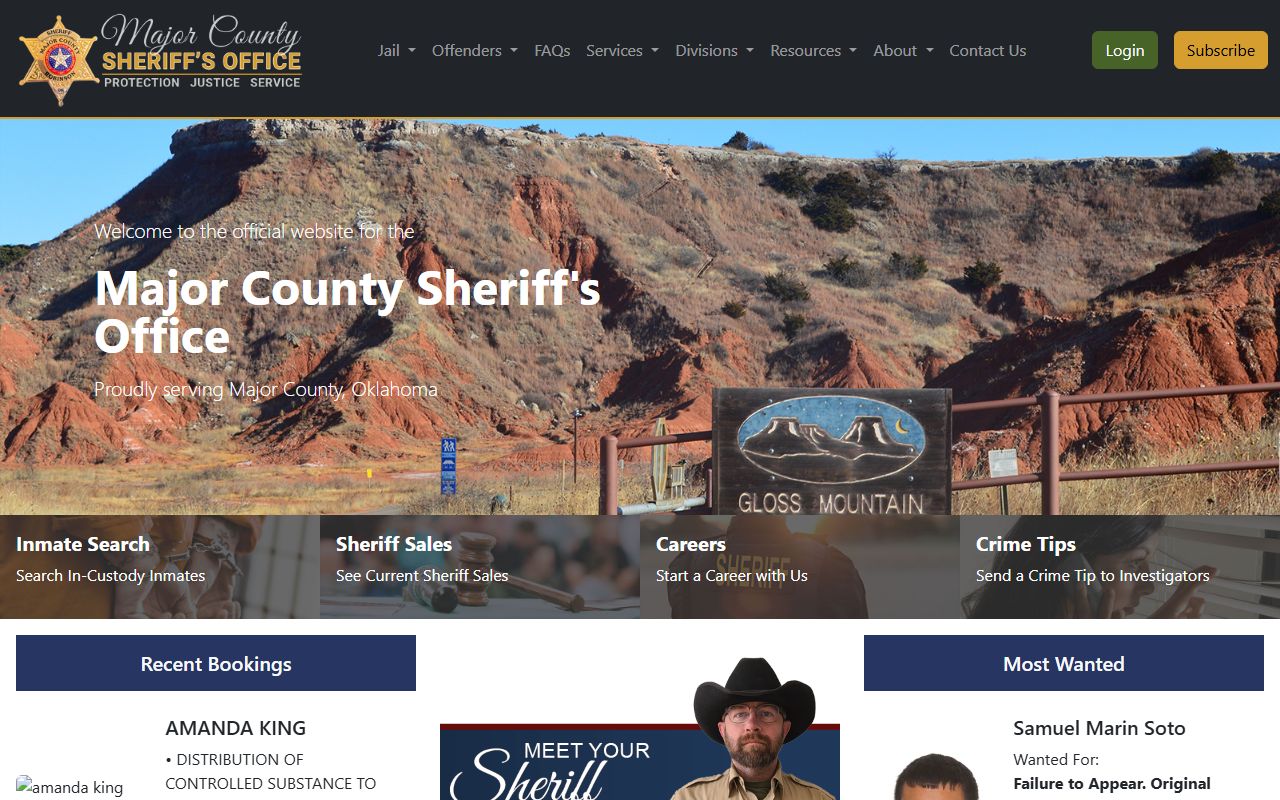
The roster shows current inmates sorted by booking date, and Oklahoma VINE serves as a fallback for released or transferred inmates and for custody notifications. For the full booking detail and roster guidance, the Major County inmate records page goes deeper, and the warrant records page covers the active warrant search and the voluntary resolution process. In-person records requests run Monday through Friday from 9 AM to 3 PM, and copy fees apply for paper, certified, and digital formats.
Marriage, Divorce, and Probate Records
Marriage and divorce records in Major County are Court Clerk records rather than state vital certificates. The Court Clerk issues marriage licenses at the courthouse, and divorce files are District Court family cases searched through ODCR or OSCN by party name. A full walkthrough of license rules and case lookups lives on the marriage and divorce records page. Probate also runs through the District Court, not a separate court, and the probate records page covers estates, guardianships, and trusts.
Probate cases use terms that trip up many readers, so a short glossary helps before a search.
- Testator
- The person who made a will.
- Executor
- The person named in a will to administer the estate.
- Administrator
- The person a court appoints when no executor is available.
- Conservator
- The person appointed to manage another person's property or finances.
- Guardian
- The person appointed to make personal or care decisions for another.
Some recorded probate documents, such as decrees and affidavits of heirship, may also show up in the County Clerk land records, which makes the two offices a useful cross-check for estate research.
Federal Courts for Major County
Some cases that touch Major County are not state matters at all. Federal crimes, civil rights suits, and federal question cases land in the United States District Court rather than the District Court in Fairview. Federal law assigns each Oklahoma county to a district, and Major County falls in the Western District of Oklahoma.
The federal statute that places Major County in the Western District, 28 U.S.C. Section 116, is shown on the page linked here on Cornell's Legal Information Institute.
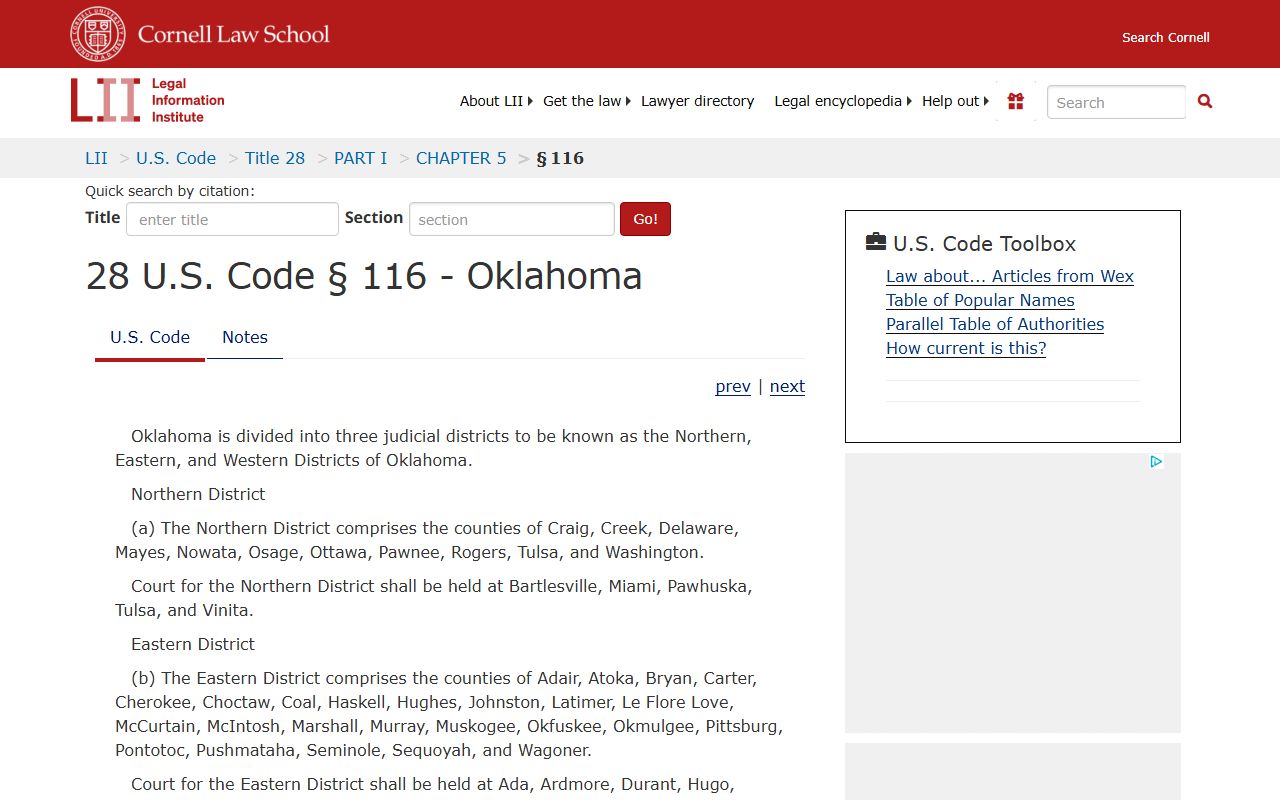
The trial court for these cases sits in Oklahoma City at 200 NW 4th Street, with a main number of 405-609-5000. Federal filings are not accepted at the Major County courthouse.
The United States District Court for the Western District of Oklahoma is shown on its official site linked here.
Federal civil and criminal dockets are accessed through PACER and the court's CM/ECF system rather than ODCR or OSCN. Bankruptcy is a separate court with its own counter and rules.
The United States Bankruptcy Court for the Western District of Oklahoma, at 215 Dean A. McGee Avenue in Oklahoma City, is shown on its official site linked here.
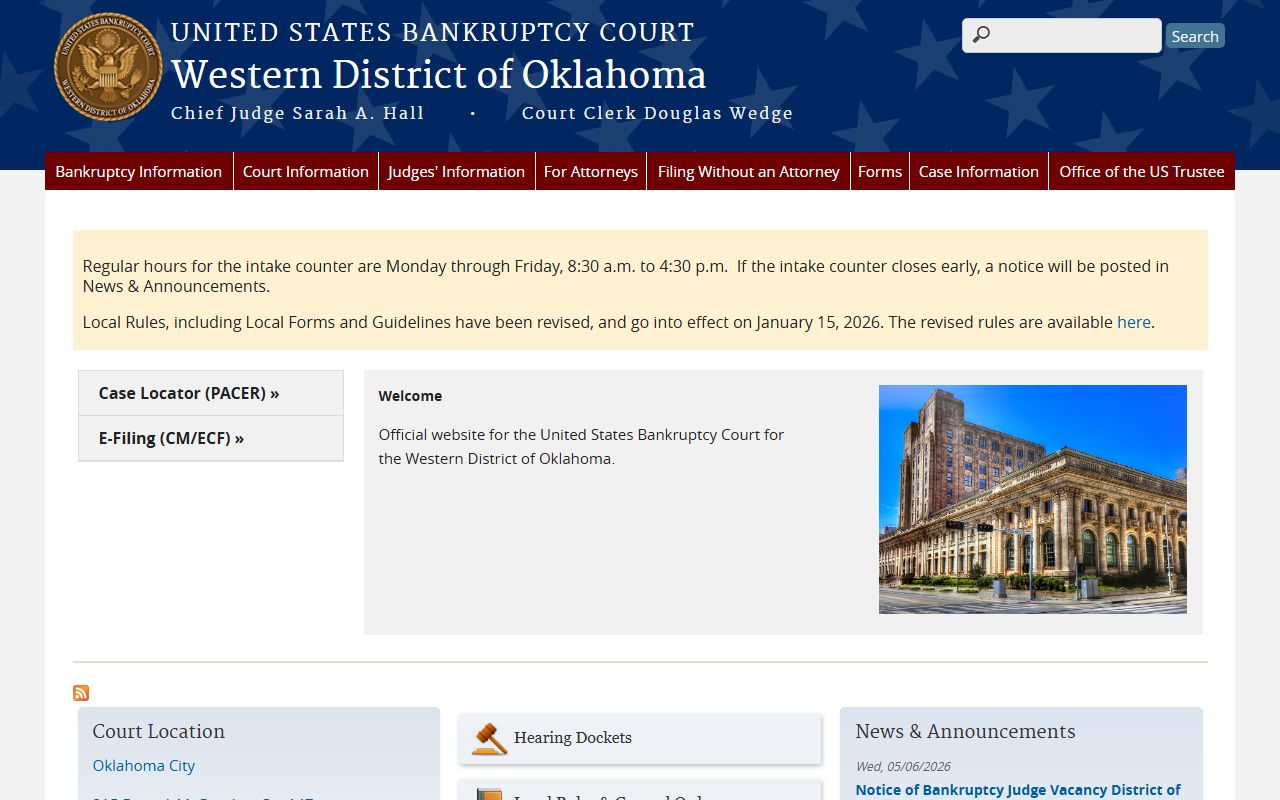
The bankruptcy court runs weekday business hours and stops accepting new paper cases at the counter after 4:00 p.m. Prosecution of federal crimes in the district falls to the United States Attorney's Office.
The United States Attorney's Office for the Western District of Oklahoma is shown on its official page linked here on justice.gov.
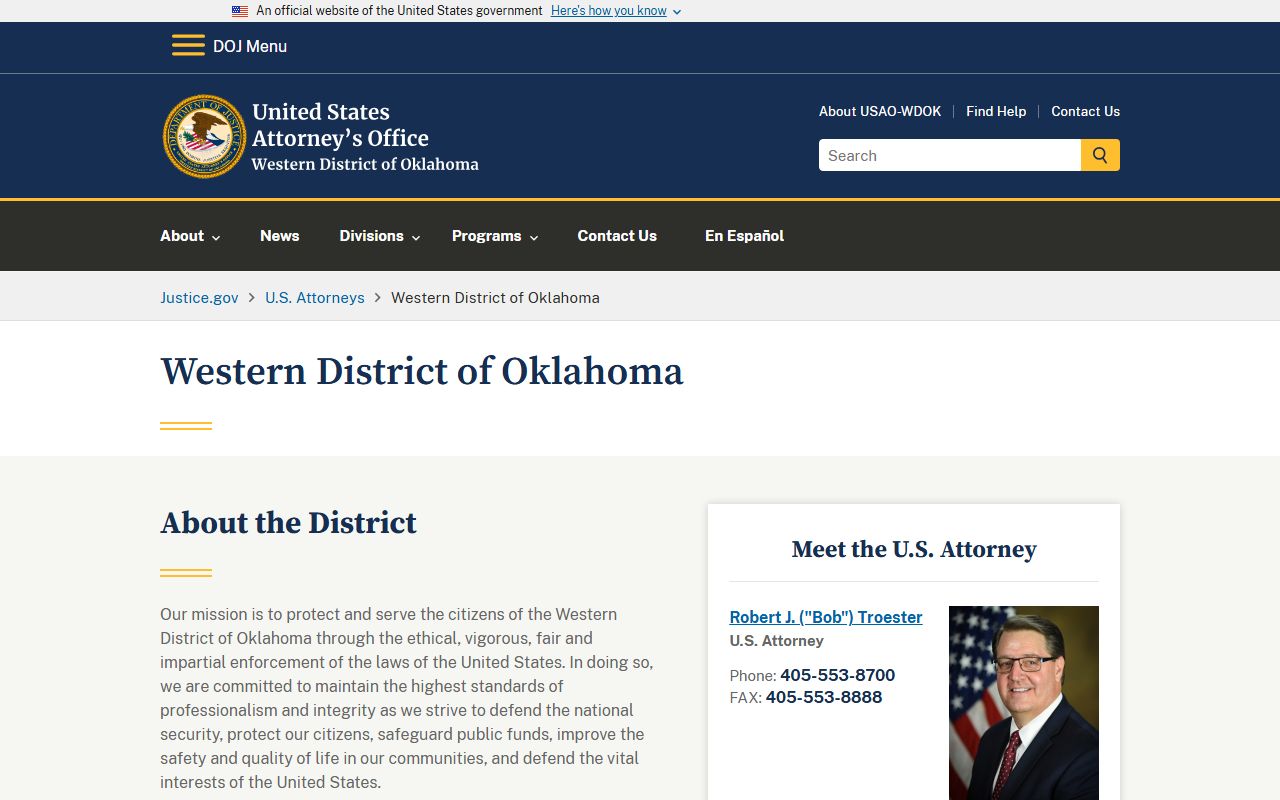
That office states the Western District is the largest of Oklahoma's three judicial districts and covers 40 of the state's 77 counties, Major County among them.
Courthouse Location and Contact Information
The Major County Courthouse stands at 500 E. Broadway in Fairview, the county seat. The building is the working home of the District Court, the Court Clerk, the County Clerk, the Sheriff's Office, and the local District Attorney office. The Court Clerk, Lindsey Keck, keeps the District Court records, issues marriage licenses, collects court fees, and serves as a passport acceptance agency. The contact cards below list the offices a records seeker contacts most.
District Judge Justin Eilers and Associate District Judge Timothy Haworth preside over Major County District Court cases, and District Attorney Christopher Boring leads prosecution for District 26. Office hours run 8:30 to 4:30 unless otherwise posted, so a quick call ahead is wise before a visit for certified copies.
Major County Court Records Fees
Fees vary by office and by the kind of copy a person needs. The Major County Court Clerk collects court fees but does not publish a filing or copy fee schedule on its online page, so the office phone line is the reliable source for current District Court copy and certification costs. Two fee sets are documented in official sources and appear below.
| Item | Amount |
|---|---|
| Sheriff plain copy per page | $0.50 |
| Sheriff certified copy per page | $1.00 |
| Sheriff DVD or thumb drive per page | $1.00 |
| ODCR public docket search | Free |
| ODCR advanced tools | $5 per month |
| ODCR attorney image access | $55 per month |
| ODCR single court image access | $25 per month |
The sheriff copy fees apply to law enforcement records such as incident reports, not to District Court case files. The ODCR rates cover online access tiers, with the free docket search being enough for most public lookups. For court filing fees and certified District Court copies, call the Court Clerk at 580-227-4690 to confirm the current amount.
History of Major County Courts
Major County was carved from the southern part of territorial Woods County at Oklahoma statehood in 1907. It was named for John Charles Major, a county resident and a delegate to the state's 1906 Constitutional Convention. Fairview became the county seat and remains the home of the courthouse and the District Court today. The land was once part of the Cherokee Outlet, opened to non-Indian settlement on September 16, 1893.
The Major County entry from the Oklahoma Historical Society, covering the county's formation and courthouse, is shown on the encyclopedia page linked here.
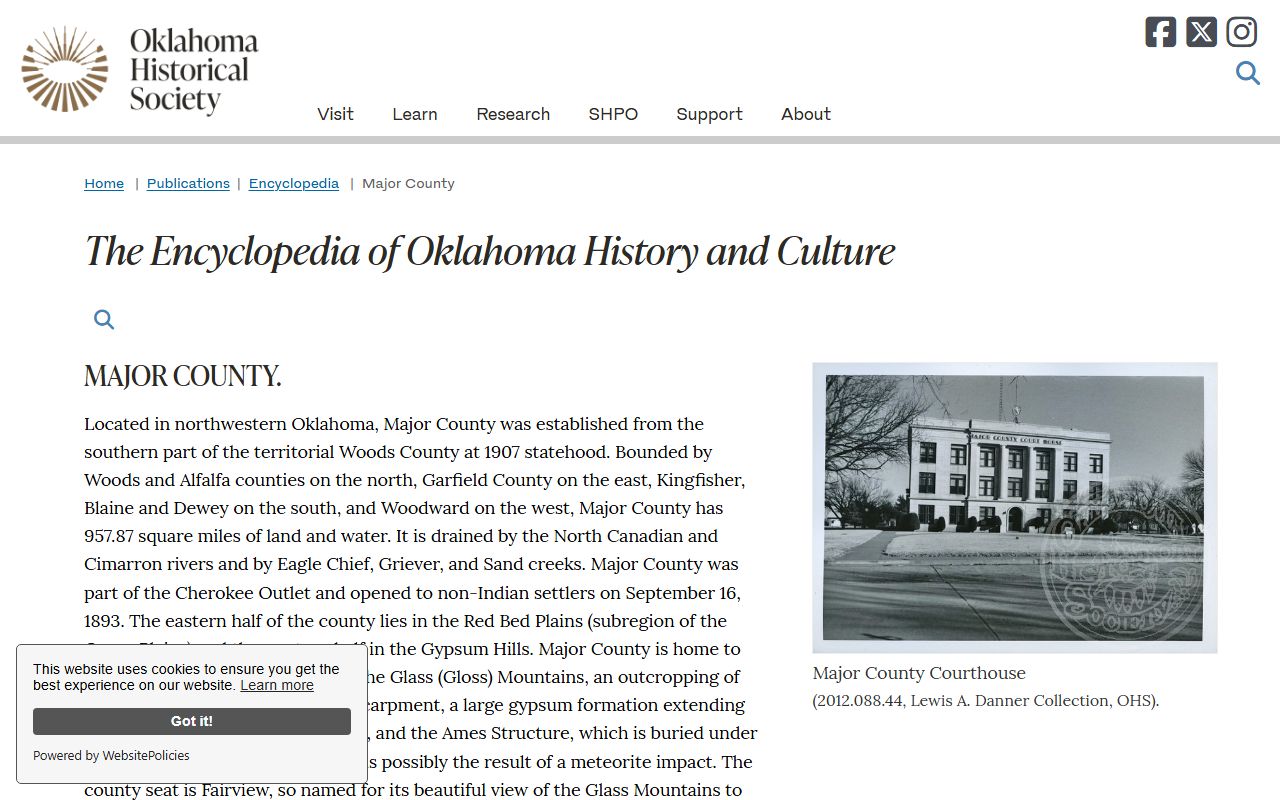
The Historical Society notes that the Major County Courthouse is listed on the National Register of Historic Places under reference NR 84003153. Courthouse history sources describe the current building as a 1928 Classical Revival design. The courthouse has anchored county government and the local court since the early twentieth century, and it still serves as the records hub for District Court files.
Local Record Context for Major County
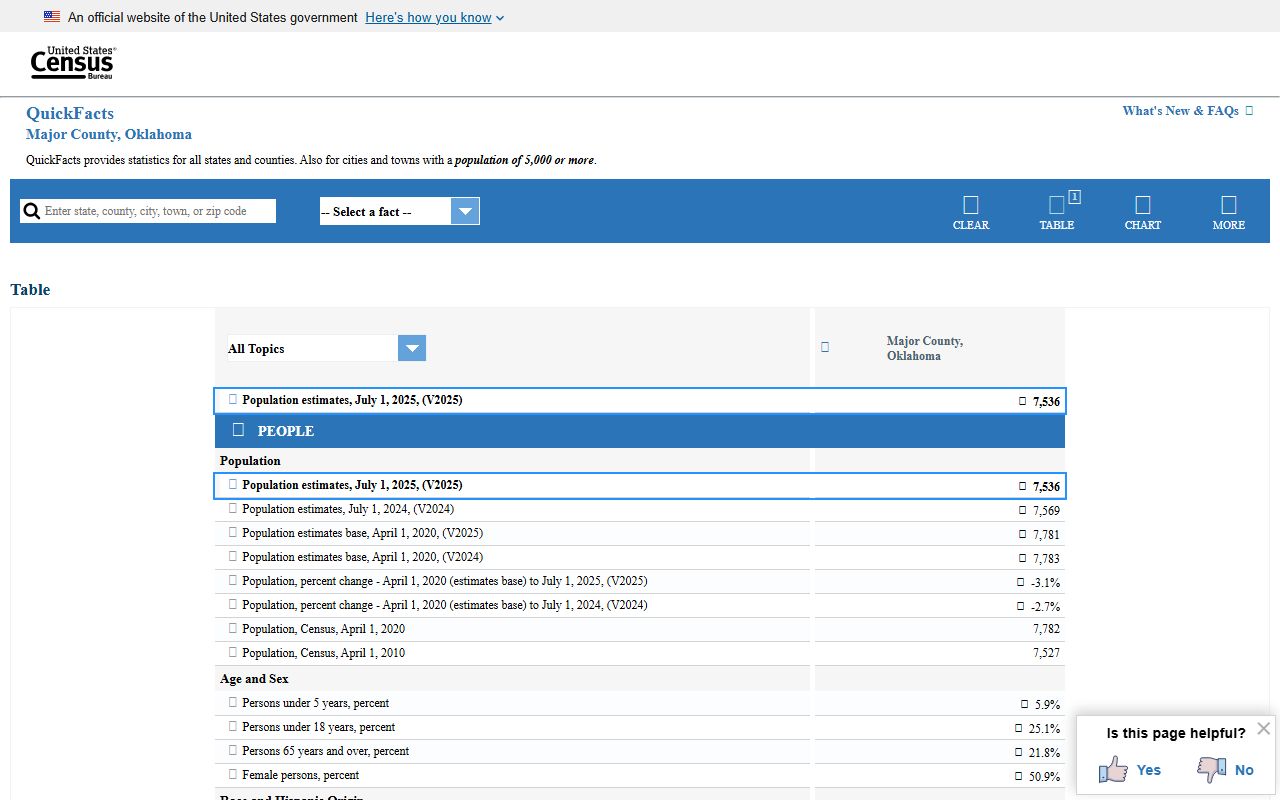
Major County is a rural county in northwestern Oklahoma, and its records reflect a community built on farming, ranching, and oil and gas. The county covers about 955 square miles and held an estimated population of 7,536 in 2025, which works out to a thin population spread across a large area. That mix shapes the kinds of cases the District Court sees and the heavy land record activity at the County Clerk.
The United States Census QuickFacts profile for Major County, with population and housing figures, is shown on the page linked here at census.gov.
Because so much local wealth ties to land and minerals, the County Clerk land portal carries many instrument types that connect to court cases, including affidavits of heirship, sheriff deeds, oil and gas leases, and probate decrees. These are County Clerk records, not District Court dockets, yet they often link to probate, civil judgments, and sheriff sale activity. Fairview sits near the Glass Mountains and the Cimarron River, and the county is reached by State Highways 8 and 58 along with U.S. Highways 60, 281, and 412.
Frequently Asked Questions
How do I search Major County court records online?
Use ODCR or OSCN, the two free statewide tools. ODCR is the system the Major County Court Clerk links from its own page, so it is a strong starting point. Choose Oklahoma District Courts, select Major, and search by a party name as Last, First, or by a case number. Read the case header to confirm the county, filing date, and parties before you rely on a result.
Who keeps Major County District Court records?
The Court Clerk is the custodian of District Court records, files, and proceedings. The office also issues marriage licenses, collects court fees, and acts as a passport acceptance agency. The County Clerk is a separate office that keeps land records and recorded instruments, not court case files. For court matters, the Court Clerk at 580-227-4690 is the right contact.
Are Major County court records free to view?
Yes, the public docket search on ODCR and OSCN is free and unlimited. You can search by name, case number, or filing date without a fee. Scanned document images are the main paid feature, and certified copies cost extra through the Court Clerk. The free docket text is enough for most public lookups.
How do I get a certified copy of a Major County court record?
Contact the Major County Court Clerk at 500 E. Broadway, Suite 5, in Fairview, or call 580-227-4690. Online dockets are not certified, so a certified copy must come from the clerk for legal use. The office does not post a copy fee schedule online, so confirm the current certified copy cost by phone before you visit.
Which Major County records are not available online?
Juvenile court records, sealed cases, expunged records, juror personal information, and records the Legislature made confidential are kept off the internet. Court of Criminal Appeals Rule 2.6 spells out these limits. Some of these records may still be viewed at the clerk's counter with proper authority, while others require a court order or a statutory role to access at all.
How do I check for a Major County warrant or inmate?
The Major County Sheriff's Office publishes an active warrant list and an online jail roster on its website. Oklahoma VINE is the fallback for released or transferred inmates and for custody notifications. The dedicated warrant records and inmate records pages cover the search fields, the resolution process, and the phone options in detail.
Does Major County have a separate probate court?
No, probate is handled inside the District Court rather than a standalone probate court. Estate, guardianship, conservatorship, and trust matters are filed as District Court cases and searched through ODCR or OSCN by the decedent or petitioner name. The Court Clerk keeps the probate case files and can confirm filing requirements and certified copy costs.